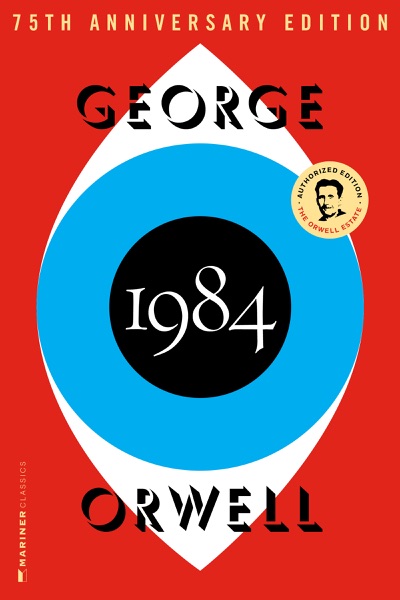
Talk to 1984 like its author wrote you back.
Get the ideas that fit your life — not generic summaries.
- Chat with the book
- Audiobook-style main ideas
- Adapts to your life and goals
- Helps you take action
1984, in detail
Nineteen Eighty-Four is George Orwell's 1949 novel about a future England called Airstrip One, governed by the totalitarian Party under the figurehead Big Brother. The Party controls all information, all language, and all recorded history. Winston Smith, a low-ranking Party functionary, spends his days rewriting old newspaper articles to bring them in line with the Party's current position. He is a functionary of the Ministry of Truth, which exists to produce lies, just as the Ministry of Love exists to produce torture and the Ministry of Peace conducts perpetual war.
The novel is structured in three parts. The first establishes the world and Winston's tentative, terrified rebellion — keeping a diary, allowing himself to think. The second follows his affair with Julia and their shared, doomed attempt to build a private life inside the surveillance state. They contact O'Brien, who appears to be a secret agent of the Brotherhood, the mythical resistance organization. The third part, in the Ministry of Love, is among the most disturbing in twentieth-century literature: the systematic disassembly of Winston's personality until he genuinely loves Big Brother.
Orwell's intellectual contribution is the concept of doublethink — the ability to hold two contradictory beliefs simultaneously and to know that they are contradictory, and to believe both — and Newspeak, a language being systematically reduced to make thoughtcrime literally impossible. The appendix on Newspeak, written in the past tense as if the Party has already fallen, is one of the more interesting of Orwell's formal choices. These are not just fictional devices; they are analyses of how authoritarian regimes actually work, drawn from Orwell's observations of Stalinist show trials and the Spanish Civil War.
The novel remains unsettling because Orwell understood that the most durable authoritarian systems do not merely suppress opposition — they reshape the desire to oppose. Winston does not simply lose; he changes. The book's power comes from its refusal to provide even the cold comfort of martyrdom. It is a warning, not a horror story, and the difference matters.
The big ideas
- 1.
Doublethink — holding two contradictory beliefs and believing both — is not a bug in authoritarian ideology but a feature. The contradiction exhausts the capacity for coherent resistance.
- 2.
Newspeak reduces the language available for thought. Orwell argues that controlling vocabulary is a more reliable way to control thought than surveillance alone.
- 3.
The Party's goal is not compliance but genuine love. O'Brien's project with Winston is not to defeat him but to transform him until he cannot want anything other than what the Party wants.
