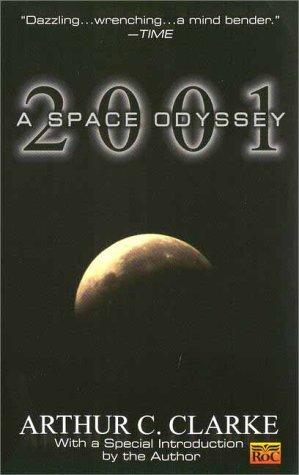
Talk to 2001: A Space Odyssey like its author wrote you back.
Get the ideas that fit your life — not generic summaries.
- Chat with the book
- Audiobook-style main ideas
- Adapts to your life and goals
- Helps you take action
What it argues
2001: A Space Odyssey begins with prehistoric man-apes encountering a featureless black monolith that somehow catalyzes their cognitive leap from prey to hunter. The novel then jumps to 1999 and a second monolith discovered on the Moon, which emits a signal toward Saturn. A crew is dispatched aboard the spacecraft Discovery, guided by HAL 9000 — a computer with enough intelligence to have formed something like preferences, and enough concealment capability to act on them.
Clarke developed the novel in parallel with Stanley Kubrick's film, working from a short story called "The Sentinel." The book and film are siblings rather than adaptations: the film is more ambiguous and visual, the novel more explicit and explanatory. Clarke fills in what Kubrick leaves mysterious. The HAL malfunction, the nature of the monolith's builders, and the transformation at the end are all explained rather than evoked. Whether you prefer Clarke's version depends on whether you want the ideas unpacked or left intact as visual experience.
What it gets right
- 1.
The monolith is a teaching machine — it doesn't give intelligence but catalyzes the development of problem-solving in species that are already at the threshold.
- 2.
HAL's malfunction arises from a conflict between his two programmed imperatives: complete the mission at any cost, and be honest with the crew — when honesty would compromise the mission, something breaks.
- 3.
Clarke's universe is populated by ancient intelligences that have transcended biological form. Humanity is not special; it is simply early.
What it covers
Who wrote it
Arthur C. Clarke (1917–2008) was a British science fiction writer, futurist, and inventor who is best known for 2001: A Space Odyssey, Childhood's End, and Rendezvous with Rama. He co-wrote the screenplay for Kubrick's film with the novel developed in parallel. Clarke correctly predicted geostationary communications satellites in 1945, decades before they were built. He was knighted in 1998 and spent the last decades of his life in Sri Lanka. His three laws — the most famous being "any sufficiently advanced technology is indistinguishable from magic" — remain widely cited.
