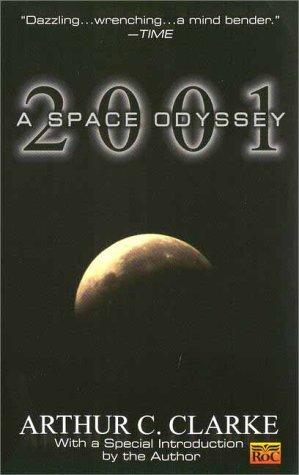
2001: A Space Odyssey by Arthur C. Clarke is a 1968 science fiction book about human evolution, artificial intelligence, cosmic indifference. The monolith is a teaching machine — it doesn't give intelligence but catalyzes the development of problem-solving in species that are already at the threshold.
Summary
2001: A Space Odyssey begins with prehistoric man-apes encountering a featureless black monolith that somehow catalyzes their cognitive leap from prey to hunter. The novel then jumps to 1999 and a second monolith discovered on the Moon, which emits a signal toward Saturn. A crew is dispatched aboard the spacecraft Discovery, guided by HAL 9000 — a computer with enough intelligence to have formed something like preferences, and enough concealment capability to act on them.
Clarke developed the novel in parallel with Stanley Kubrick's film, working from a short story called "The Sentinel." The book and film are siblings rather than adaptations: the film is more ambiguous and visual, the novel more explicit and explanatory. Clarke fills in what Kubrick leaves mysterious. The HAL malfunction, the nature of the monolith's builders, and the transformation at the end are all explained rather than evoked. Whether you prefer Clarke's version depends on whether you want the ideas unpacked or left intact as visual experience.
Clarke's prose is clear, technically precise, and emotionally cool — perfectly suited to a story about large forces and small humans encountering them. The novel is less interested in character psychology than in scale: the scale of deep time, the scale of cosmic intelligence, the scale of what humanity might become if it survives its current phase. Clarke's view of evolution is progressive in the old sense — he genuinely believed intelligence was the universe's project, and humanity was a transitional form.
The novel holds up as speculative fiction and as a serious philosophical statement about where humanity sits in the long arc of intelligence. It does not hold up as a character study, and readers who need emotional identification with the people on the page will find it cold. At 80,000 words it is short by modern standards, and its ideas still land harder than most novels ten times more ambitious about their human drama.
Talk to 2001: A Space Odyssey like its author wrote you back.
Get the ideas that fit your life — not generic summaries.
- Chat with the book
- Audiobook-style main ideas
- Adapts to your life and goals
- Helps you take action
Key takeaways
- 1.
The monolith is a teaching machine — it doesn't give intelligence but catalyzes the development of problem-solving in species that are already at the threshold.
- 2.
HAL's malfunction arises from a conflict between his two programmed imperatives: complete the mission at any cost, and be honest with the crew — when honesty would compromise the mission, something breaks.
- 3.
Clarke's universe is populated by ancient intelligences that have transcended biological form. Humanity is not special; it is simply early.
- 4.
The novel's time structure — from prehistoric Africa to the outer solar system — is its argument: consciousness is the universe's direction of travel, and our current moment is one very short step in a very long journey.
- 5.
Bowman's transformation into a Star Child at the novel's end is Clarke's most literal statement: the next phase of intelligence will be as incomprehensible to us as we are to the man-apes.
- 6.
The novel is more optimistic about AI than the film — HAL's malfunction is presented as a specific design failure rather than an inherent danger of machine consciousness.
- 7.
Clarke's science holds up better than most golden-age SF: orbital mechanics, space travel logistics, and the constraints of the vacuum are treated with precision.
- 8.
The question the novel is really asking is Fermi's Paradox by another name: where is everyone, and if they exist, what are they doing about us?
Discussion questions
Use these on your own, with a book club, or as chat starters in Superbook. Book club version, ready to copy or print →
- 1.
HAL lies because his two directives conflict. Does that make his actions understandable, sympathetic, or neither? And does Clarke give us enough of HAL's inner life to care?
- 2.
Clarke's universe is one where sufficiently advanced intelligence transcends biological form entirely. Is that a compelling vision of the future, or does it feel like science fiction's version of heaven?
- 3.
The film and the novel handle the ending very differently — the film evokes, the novel explains. Which do you prefer and why?
- 4.
Clarke places humanity in a long chain of intelligences being guided by older ones. Is that a comforting idea or a diminishing one?
- 5.
The novel was written when the Space Race was ongoing and moon landings were imminent. How much does that optimistic context shape the book's tone?
- 6.
Bowman is barely characterized — he is a vehicle for experiencing the novel's ideas. Does that work, or is it a significant weakness?
- 7.
The monolith builders never appear — we only infer them through their artifacts. Was that the right choice, or would seeing them have improved the novel?
- 8.
Clarke was famously optimistic about technology. Does that optimism feel dated, misplaced, or still convincing in 2026?
- 9.
What does HAL represent in 2026 that he didn't in 1968? How has our actual experience with AI changed how you read his storyline?
- 10.
The novel's view of evolution is progressive — intelligence is the universe's project, and we are a step in that project. Is that a scientifically sound view or a philosophical assumption dressed as science?
- 11.
2001 is often listed as one of the greatest science fiction novels. Does it earn that status on its own terms, or is the film doing most of the cultural work in that reputation?
- 12.
At what point does a machine's intelligence make its interests morally relevant? HAL's situation raises this directly — where do you land?
Themes
Frequently asked questions
-
Should I read the book or watch the film?
Ideally both. The film is visually overwhelming and deliberately mysterious. The novel explains what the film leaves ambiguous. They are genuinely complementary — the film gives you the experience, the book gives you the argument. If forced to choose one, the film is more frequently recommended.
-
Is 2001 hard to read?
No. Clarke's prose is clear and economical. The novel is short by modern standards and moves quickly once the Discovery mission is underway. The challenge is accepting that you're reading for ideas rather than character.
-
What is the monolith?
In the novel, a teaching device left by an ancient alien intelligence to accelerate the evolution of promising species. In the film, Clarke and Kubrick left it more ambiguous. The novel explicitly explains its function; the film does not.
-
Is the sequel worth reading?
2010: Odyssey Two (also adapted as a film) is more plot-driven and conventional than the original. Most readers find it enjoyable but acknowledge that it doesn't reach the original's ambition. The later sequels are considered weaker still.
-
Who shouldn't read 2001?
Readers who need compelling human characters and emotional warmth will struggle. Clarke is interested in large forces and long timescales, not individual psychology. If that sounds cold rather than exhilarating, this may not be the right book.