Science · Book club
A Brief History of Time book club questions
Here are 12 book club questions for A Brief History of Time by Stephen Hawking, ordered to open easily and end somewhere worth arguing about. Copy them, print them, or bring them up one at a time.
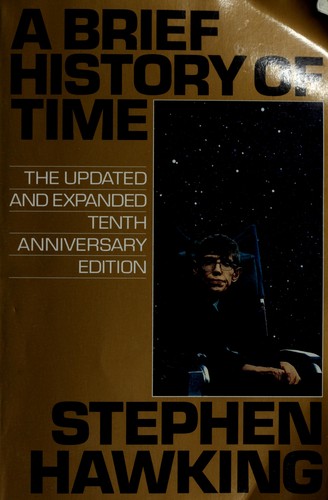
A Brief History of Time is Stephen Hawking's attempt to explain the biggest questions in physics — where the universe came from, how it behaves, and where it might be going — to readers with no scientific training.
Stephen Hawking · 1988 · 4h 0m
Full summary and key takeaways →The 12 questions
- 1.
Hawking argues that asking what happened before the Big Bang may be a meaningless question. Does that answer satisfy you, or does it feel like an evasion?
- 2.
The no-boundary proposal removes the need for a cause of the universe. What are the implications of that for how you think about creation and existence?
- 3.
Hawking is honest that a final theory of everything was expected in his lifetime and hasn't arrived. How does science remain motivating when the central goal keeps receding?
- 4.
Black holes emit radiation and eventually evaporate — but where does the information they absorbed go? Why does this question still matter decades after Hawking raised it?
- 5.
The book connects the arrow of time to entropy. Does that explanation feel like a complete account of why the past feels so different from the future?
- 6.
Hawking writes about the anthropic principle: we observe these physical constants because other constants wouldn't allow us to exist. Is that reasoning compelling or circular?
- 7.
The book was written for non-experts, yet some readers find it genuinely difficult. Where did you lose the thread, and did that change how you think about scientific popularization?
- 8.
Hawking spent his career on questions that may never be empirically verified in his lifetime. What does that tell us about the relationship between physics and philosophy?
- 9.
If a unified theory of everything were found tomorrow, Hawking suggests it would be knowable in principle by anyone. Do you believe that? What would it actually mean to understand the universe?
- 10.
The book was first published in 1988. Which parts feel dated, and which feel as urgent as ever?
- 11.
Hawking's personal circumstances — writing and thinking under severe physical constraint — are present in the background of the book. Does knowing that change how you read it?
- 12.
Which concept in the book most changed how you picture the physical world: spacetime curvature, event horizons, Hawking radiation, or something else?
How to run the discussion
- Pick six to eight, not all of them. An hour of real discussion covers fewer questions than anyone expects, and racing the list is what makes a book club feel like homework.
- Open with what people noticed, not what they concluded. Asking for a verdict first hardens opinions before anyone has heard each other.
- Let the disagreement run. The questions below that split a room are the ones worth the time; the ones everyone answers the same way can be skipped.
- Ask the quiet person a specific question. A direct, narrow question is far easier to answer than an open invitation to contribute.
Themes worth steering toward
If the conversation stalls, these are the threads that usually restart it.
Common questions
What are good book club questions for A Brief History of Time?
Here are 12 book club questions for A Brief History of Time by Stephen Hawking, ordered to open easily and end somewhere worth arguing about. The strongest openers ask what each reader noticed rather than what they concluded, and the discussion usually turns on cosmology, space and time, the universe's origins.
How long should a book club discussion of A Brief History of Time last?
Most groups run 60 to 90 minutes of actual discussion. That is roughly six to eight questions, not all of them, so pick the ones that suit your group rather than working down the list in order.
What are the main themes in A Brief History of Time?
Cosmology, Space and time, The universe's origins, Quantum mechanics, Black holes. Those are the threads most likely to divide a room, which makes them the useful places to steer a discussion that has gone quiet.
Picking the next one? See books like A Brief History of Time or questions for other book club picks.
