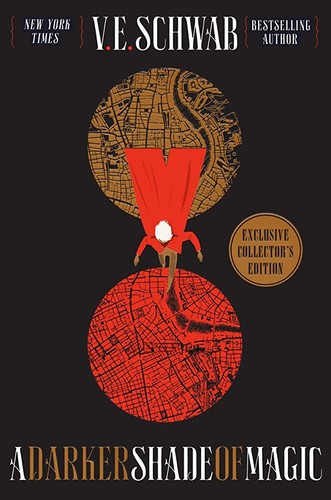
Talk to A Darker Shade of Magic like its author wrote you back.
Get the ideas that fit your life — not generic summaries.
- Chat with the book
- Audiobook-style main ideas
- Adapts to your life and goals
- Helps you take action
A Darker Shade of Magic, in detail
A Darker Shade of Magic is set across four parallel versions of London — Red, Grey, White, and the long-destroyed Black — each existing in the same location but separated by the barriers between worlds. Kell is one of the last Antari, magicians rare enough to travel between these Londons, and he works as a royal messenger for the throne of Red London. He also, quietly, smuggles contraband between worlds. When one such piece of contraband turns out to be something far more dangerous than a trinket, it sets off a chase that threatens to undo the careful balance keeping the worlds apart.
The book is primarily about what power costs and who gets to wield it. Red London is vibrant and balanced; White London is brutal, its rulers literally feeding off the magic of everyone around them; Black London was consumed entirely by the power it invited in. Kell sits at the center of this history, useful to the crown but never quite trusted, loyal to a family that adopted him but never fully belonging. The thief Delilah Bard, who stumbles into his crisis from a Grey London that has forgotten magic exists at all, brings a different kind of energy — she wants out of her world, not to protect it.
Schwab's particular strength is pace. The book moves fast, cuts between perspectives cleanly, and never lingers long enough to become indulgent. The world-building is efficient: instead of front-loading lore, she lets the detail accumulate through action. The four-London structure gives the story an unusual architecture — same geography, radically different histories — and the contrast between them does a lot of thematic work that exposition would fumble.
Readers who want dense, intricate fantasy systems or substantial character interiority may find this a bit lean. It reads more like a heist-adventure with magical infrastructure than high fantasy. But as a first book in a trilogy, it does exactly what it needs to: it establishes a world worth spending time in, a pair of leads you want to follow, and a stakes structure that lands. The sequels escalate considerably; most readers who enjoy this one will read all three.
The big ideas
- 1.
The four-London structure is the novel's central idea: same city, wildly different histories depending on how each world has related to magic — balanced, totalitarian, forgotten, or destroyed.
- 2.
Kell's Antari status makes him exceptional and expendable simultaneously. The book is attentive to what it means to be useful to power without being trusted by it.
- 3.
Delilah Bard is a deliberate inversion of the 'chosen one' trope — she has no destiny, no magic, and no permission. She forces her way into significance by sheer will.
