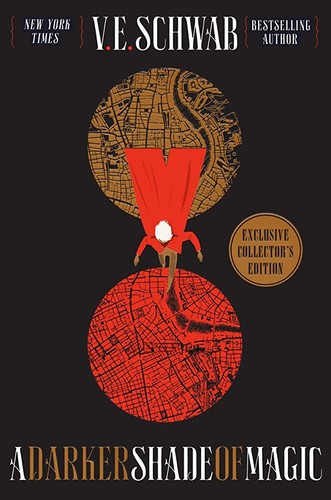
A Darker Shade of Magic by V.E. Schwab is a 2015 fantasy book about parallel worlds, power and corruption, identity and belonging. The four-London structure is the novel's central idea: same city, wildly different histories depending on how each world has related to magic — balanced, totalitarian, forgotten, or destroyed.
Summary
A Darker Shade of Magic is set across four parallel versions of London — Red, Grey, White, and the long-destroyed Black — each existing in the same location but separated by the barriers between worlds. Kell is one of the last Antari, magicians rare enough to travel between these Londons, and he works as a royal messenger for the throne of Red London. He also, quietly, smuggles contraband between worlds. When one such piece of contraband turns out to be something far more dangerous than a trinket, it sets off a chase that threatens to undo the careful balance keeping the worlds apart.
The book is primarily about what power costs and who gets to wield it. Red London is vibrant and balanced; White London is brutal, its rulers literally feeding off the magic of everyone around them; Black London was consumed entirely by the power it invited in. Kell sits at the center of this history, useful to the crown but never quite trusted, loyal to a family that adopted him but never fully belonging. The thief Delilah Bard, who stumbles into his crisis from a Grey London that has forgotten magic exists at all, brings a different kind of energy — she wants out of her world, not to protect it.
Schwab's particular strength is pace. The book moves fast, cuts between perspectives cleanly, and never lingers long enough to become indulgent. The world-building is efficient: instead of front-loading lore, she lets the detail accumulate through action. The four-London structure gives the story an unusual architecture — same geography, radically different histories — and the contrast between them does a lot of thematic work that exposition would fumble.
Readers who want dense, intricate fantasy systems or substantial character interiority may find this a bit lean. It reads more like a heist-adventure with magical infrastructure than high fantasy. But as a first book in a trilogy, it does exactly what it needs to: it establishes a world worth spending time in, a pair of leads you want to follow, and a stakes structure that lands. The sequels escalate considerably; most readers who enjoy this one will read all three.
Talk to A Darker Shade of Magic like its author wrote you back.
Get the ideas that fit your life — not generic summaries.
- Chat with the book
- Audiobook-style main ideas
- Adapts to your life and goals
- Helps you take action
Key takeaways
- 1.
The four-London structure is the novel's central idea: same city, wildly different histories depending on how each world has related to magic — balanced, totalitarian, forgotten, or destroyed.
- 2.
Kell's Antari status makes him exceptional and expendable simultaneously. The book is attentive to what it means to be useful to power without being trusted by it.
- 3.
Delilah Bard is a deliberate inversion of the 'chosen one' trope — she has no destiny, no magic, and no permission. She forces her way into significance by sheer will.
- 4.
White London's rulers consume magic by consuming those around them — a literal metaphor for how authoritarianism sustains itself at everyone else's expense.
- 5.
The price of magic is a recurring motif across the trilogy. Nothing is free; the question is who pays and whether they know they're paying.
- 6.
Belonging is more fraught than adventure for Kell. He was collected, not born into his family. The gap between affection and trust runs through every scene with the Maresh royals.
- 7.
The novel rewards readers who pay attention to what each London's relationship to magic says about its politics — a consistent, earned form of world-building.
- 8.
Schwab's pacing is intentional: the book teaches you to trust momentum over exposition. What's left unexplained early is answered by what happens next.
Discussion questions
Use these on your own, with a book club, or as chat starters in Superbook. Book club version, ready to copy or print →
- 1.
The four Londons exist on a spectrum from too little magic (Grey) to destroyed by too much (Black). Where does Red London sit on that spectrum, and is its balance stable or just temporarily lucky?
- 2.
Kell was taken in by the Maresh family as a child. The novel suggests he was collected more than adopted. Do you read the Maresh family as loving, exploitative, or genuinely unable to tell the difference?
- 3.
Delilah says she wants to see other worlds, not save this one. By the end of the book, has that changed, or is she still primarily acting for her own reasons?
- 4.
White London's magic is predatory — its rulers survive by draining everyone else. Does the novel suggest this is a choice its leaders made, or an inevitable consequence of how that world evolved?
- 5.
Kell breaks the rules by smuggling. His justification is that it's harmless. Does the novel agree, or is it showing us that even small transgressions have consequences we can't foresee?
- 6.
Grey London has forgotten magic exists. Is that presented as a loss, a protection, or both? What does Lila's reaction to magic suggest about the novel's answer?
- 7.
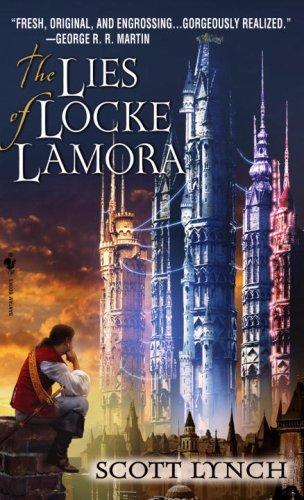
Compared to something like The Lies of Locke Lamora or Mistborn, A Darker Shade of Magic is lighter on moral ambiguity. Is that a feature or a limitation for you as a reader?
- 8.
The magic in this book is tied to language and intention. What does that design choice say about how Schwab thinks about power?
- 9.
Kell and Lila are both people on the outside of systems that want to use them. What does their partnership reveal about why outsiders sometimes make better allies than insiders?
- 10.
The book ends with consequences that are resolved but not fully processed. Does the emotional resolution feel earned, or does the pace work against it?
- 11.
Schwab is a prolific author with a strongly commercial sensibility. Do you find that a strength (accessible, propulsive) or a limitation (lacks depth)? What would it take for this to become a book you'd re-read?
- 12.
If you were to visit one of the four Londons as a tourist — knowing you had no magic — which would you choose, and why?
Themes
Frequently asked questions
-
Is A Darker Shade of Magic a standalone novel?
No. It's the first book in the Shades of Magic trilogy, followed by A Gathering of Shadows and A Conjuring of Light. The first book has a complete arc, but the larger story is resolved across all three.
-
How hard is A Darker Shade of Magic to read?
It's not hard at all — it's one of the more accessible fantasy novels of the decade. The world-building is layered in gradually, the prose is clean, and the pacing is fast. Readers who struggle with dense fantasy systems will find this approachable.
-
What is A Darker Shade of Magic about, without spoilers?
A rare magician who can travel between four parallel versions of London gets tangled in a conspiracy that could destroy the balance between worlds. He picks up an unlikely ally, a thief from a London that has forgotten magic exists.
-
Who shouldn't read A Darker Shade of Magic?
Readers who want substantial interiority, slow world-building, or morally gray complexity. This is a propulsive adventure story — if you want George R.R. Martin or Gene Wolfe territory, this will feel thin.
-
Is there a TV adaptation?
As of 2024, a television adaptation has been in development but has not aired. The trilogy is well-suited to a visual adaptation given its clear visual architecture.