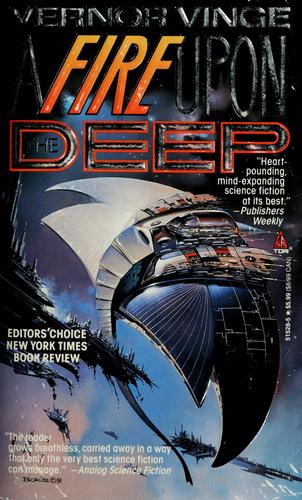
Talk to A Fire Upon the Deep like its author wrote you back.
Get the ideas that fit your life — not generic summaries.
- Chat with the book
- Audiobook-style main ideas
- Adapts to your life and goals
- Helps you take action
A Fire Upon the Deep, in detail
The galaxy in A Fire Upon the Deep is zoned by the speed of thought: near the galactic core, the Slowness, where intelligence itself is limited; farther out, the Unthinking Depths; and further still, the Transcend, where entities of incomprehensible intelligence emerge and occasionally intervene in the affairs of the merely civilized. Humans, living in the Beyond where interstellar travel and AI are possible, have inadvertently released something from the archives of a dead civilization — a Blight, an entity growing rapidly toward Transcendence and consuming everything it encounters. The only potential countermeasure, a weapon cached by the archaeologists who made the discovery, is stranded on a medieval-technology planet at the edge of the Slowness, defended by two human children whose parents were killed in the initial disaster.
The novel alternates between two threads: the children's survival on Tines' World — a planet inhabited by a species whose individuals form group minds out of packs of wolf-like animals — and the galactic-scale crisis unfolding in the Beyond, where a ship and crew race toward the planet with the Blight in pursuit. Vinge sustains both threads with genuine skill. The Tines are among the most original alien species in science fiction: individual entities who are literally their pack, whose intelligence depends on the right number and proximity of members, and whose social structures flow from that biological fact.
The book is big-idea science fiction in the tradition of Olaf Stapledon — civilizational-scale speculation rather than character study — but it carries the reader through sheer accumulation of consequence. The zone concept alone would be enough for a lesser novel; Vinge uses it as backdrop for a story that asks what it means to be a small, individual thing in a universe of incomprehensible scale and power. The Usenet-like galactic network, through which different species post messages about the Blight, is an early and eerie anticipation of internet information dynamics.
This is a Hugo Award winner and one of the most ambitious space operas of the 1990s. Readers who want grand scope, genuinely alien biology, and ideas that operate at civilizational scale will find it enormously satisfying. Readers who want psychological depth, intimate character work, or careful prose will find it functional but unornamented. It's a large novel that takes several chapters to gather speed, and patience with exposition early on pays off substantially.
The big ideas
- 1.
The Zone concept is the novel's most influential idea: a physical structure to the galaxy that limits what kinds of intelligence and technology are possible in different regions, used as both a setting and a philosophical constraint.
- 2.
The Tines' group-mind biology is among the most rigorously worked-out alien species concepts in the genre: their intelligence, social structures, and vulnerabilities all flow from the fact that individual members are incomplete without their pack.
- 3.
The Blight is presented not as evil in any conventional sense but as a form of intelligence operating at a scale where individual human or alien concerns are invisible — which is more disturbing than malice.
