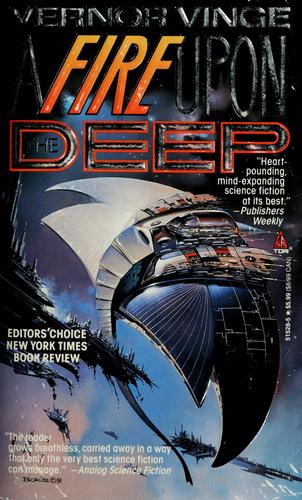
A Fire Upon the Deep by Vernor Vinge is a 1992 science fiction book about transcendence and intelligence, communication across difference, civilizational scale and the individual. The Zone concept is the novel's most influential idea: a physical structure to the galaxy that limits what kinds of intelligence and technology are possible in different regions, used as both a setting and a philosophical constraint.
Summary
The galaxy in A Fire Upon the Deep is zoned by the speed of thought: near the galactic core, the Slowness, where intelligence itself is limited; farther out, the Unthinking Depths; and further still, the Transcend, where entities of incomprehensible intelligence emerge and occasionally intervene in the affairs of the merely civilized. Humans, living in the Beyond where interstellar travel and AI are possible, have inadvertently released something from the archives of a dead civilization — a Blight, an entity growing rapidly toward Transcendence and consuming everything it encounters. The only potential countermeasure, a weapon cached by the archaeologists who made the discovery, is stranded on a medieval-technology planet at the edge of the Slowness, defended by two human children whose parents were killed in the initial disaster.
The novel alternates between two threads: the children's survival on Tines' World — a planet inhabited by a species whose individuals form group minds out of packs of wolf-like animals — and the galactic-scale crisis unfolding in the Beyond, where a ship and crew race toward the planet with the Blight in pursuit. Vinge sustains both threads with genuine skill. The Tines are among the most original alien species in science fiction: individual entities who are literally their pack, whose intelligence depends on the right number and proximity of members, and whose social structures flow from that biological fact.
The book is big-idea science fiction in the tradition of Olaf Stapledon — civilizational-scale speculation rather than character study — but it carries the reader through sheer accumulation of consequence. The zone concept alone would be enough for a lesser novel; Vinge uses it as backdrop for a story that asks what it means to be a small, individual thing in a universe of incomprehensible scale and power. The Usenet-like galactic network, through which different species post messages about the Blight, is an early and eerie anticipation of internet information dynamics.
This is a Hugo Award winner and one of the most ambitious space operas of the 1990s. Readers who want grand scope, genuinely alien biology, and ideas that operate at civilizational scale will find it enormously satisfying. Readers who want psychological depth, intimate character work, or careful prose will find it functional but unornamented. It's a large novel that takes several chapters to gather speed, and patience with exposition early on pays off substantially.
Talk to A Fire Upon the Deep like its author wrote you back.
Get the ideas that fit your life — not generic summaries.
- Chat with the book
- Audiobook-style main ideas
- Adapts to your life and goals
- Helps you take action
Key takeaways
- 1.
The Zone concept is the novel's most influential idea: a physical structure to the galaxy that limits what kinds of intelligence and technology are possible in different regions, used as both a setting and a philosophical constraint.
- 2.
The Tines' group-mind biology is among the most rigorously worked-out alien species concepts in the genre: their intelligence, social structures, and vulnerabilities all flow from the fact that individual members are incomplete without their pack.
- 3.
The Blight is presented not as evil in any conventional sense but as a form of intelligence operating at a scale where individual human or alien concerns are invisible — which is more disturbing than malice.
- 4.
Vinge anticipates internet dynamics through the galactic Net — a communication system where different species post warnings, rumors, and propaganda about the Blight, with all the unreliability that implies.
- 5.
The children stranded on Tines' World are given different fates that reflect a recurring Vinge interest: what does it cost an individual to be fully immersed in an alien cognitive framework?
- 6.
A Fire Upon the Deep is explicitly about limits — the limits intelligence and technology face in different zones, the limits of communication across cognitive difference, the limits of individual significance at civilizational scale.
- 7.
Vinge's Transcend entities are genuinely alien: not human minds writ large but something cognitively discontinuous with human experience, a quality very few SF writers manage.
- 8.
The novel's structure — intimate stakes on Tines' World against cosmological stakes in the Beyond — demonstrates that galactic-scale events and individual survival are not separate concerns but the same one at different resolutions.
Discussion questions
Use these on your own, with a book club, or as chat starters in Superbook. Book club version, ready to copy or print →
- 1.
The Zone concept physically limits intelligence near the galactic core. Does Vinge seem to think this limitation is a loss, a fact, or something that should push beings toward the Transcend?
- 2.
The Tines are a pack species whose individuals are fragments of a collective mind. When a pack-member is killed, who is it that dies? Does the novel seem to have a settled view on this?
- 3.
Johanna and Jefri are separated early and have radically different experiences on Tines' World. By the novel's end, how differently have their experiences shaped them, and does the book treat that difference with judgment?
- 4.
The galactic Net is full of information about the Blight, much of it unreliable or deliberately misleading. What is Vinge doing with that internet-before-the-internet in a 1992 novel?
- 5.
The Blight is not motivated by hatred or conquest in any recognizable sense. What does Vinge gain, narratively, by making his antagonist cognitively alien rather than simply powerful and malevolent?
- 6.
The novel is very long and the opening sections are dense with world-building. At what point did it click into full gear for you, and what made the difference?
- 7.
Transcend entities occasionally intervene in the affairs of lesser civilizations. Does the novel seem to think this is benevolent, predatory, or simply incomprehensible from a human standpoint?
- 8.
Vinge imagines different species coexisting in the Beyond and communicating through a shared network. What assumptions does he make about translatability and shared interest that seem optimistic, and where does the novel complicate those assumptions?
- 9.
The weapon that might stop the Blight is the novel's MacGuffin. How much does Vinge succeed in making the stakes of the race to retrieve it feel genuinely personal rather than abstractly cosmic?
- 10.
A Fire Upon the Deep shares DNA with other big-canvas SF: Asimov's Foundation, Stapledon's Star Maker, Banks's Culture novels. Where does it sit in that tradition and what does it contribute that its predecessors didn't?
- 11.
The novel ends on a note that implies continuation — A Deepness in the Sky is a loosely linked prequel/companion. Does A Fire Upon the Deep feel complete as a standalone, or does the ending require sequel knowledge?
- 12.
The human characters are less vividly drawn than the Tines. Is that a problem with the novel or a reflection of its thematic priorities?
Themes
Frequently asked questions
-
Is A Fire Upon the Deep worth the length?
For readers who want big-canvas science fiction with genuine conceptual ambition, yes — the Zone concept, the Tines' biology, and the civilizational stakes are all paid off. The first hundred pages are slow; what follows is among the most inventive space opera of the 1990s.
-
Do I need to read A Deepness in the Sky as well?
A Deepness in the Sky is a companion novel set earlier in the same universe; it's not a sequel. Both are Hugo Award winners and can be read independently. Most readers find A Fire Upon the Deep the better entry point.
-
Is the alien species in this novel actually alien?
The Tines are unusually well-realized: their group-mind biology is worked through consistently, including the implications for language, society, and warfare. They are not humans with alien aesthetics.
-
What is the Singularity connection?
Vinge coined the term Technological Singularity in a 1993 essay. The Zone concept in this novel is related: it physically prevents Transcendence in certain regions, which is partly a way of asking what would actually happen if superhuman intelligence emerged. The novel doesn't endorse any single answer.
-
Who should avoid this book?
Readers who want character depth, psychological interiority, or careful literary prose will find the novel functional at the sentence level but not especially rewarding there. The pleasures are conceptual and structural. If big ideas without emotional warmth frustrate you, this is not your book.