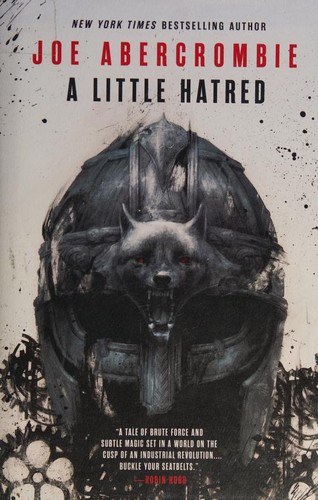
Talk to A Little Hatred like its author wrote you back.
Get the ideas that fit your life — not generic summaries.
- Chat with the book
- Audiobook-style main ideas
- Adapts to your life and goals
- Helps you take action
A Little Hatred, in detail
A Little Hatred is the first book in Abercrombie's The Age of Madness trilogy, set in the same world as his First Law trilogy but a generation later. The Circle of the World is experiencing something like an industrial revolution: factories are replacing craftsmen, machines are displacing workers, and the tensions between an entrenched aristocracy and an emerging working class are hardening into violence. The novel follows a large ensemble — soldiers, nobles, workers, scheming politicians, and the next generation of the First Law's key families — as the old world order begins to crack.
What Abercrombie is doing here is bringing grimdark fantasy into contact with recognizable historical dynamics. The Breakers are proto-revolutionary labor agitators. The Great Change is what happens when systems of power refuse to accommodate the people they're grinding up. The Union is Britain at the start of the 19th century: prosperous on paper, deeply unjust underneath. The familiar fantasy trappings — magic, swords, war — exist in a world where the defining question is who controls the new power of machines and capital, not who sits on the throne.
Abercrombie's strength is characterization under pressure. His people are complicated in ways that feel earned rather than forced: Savine dan Glokta is a fascinating figure, combining her father's strategic intelligence with a ruthless investor's eye; Leo dan Brock is brave and stupid in proportions that make him genuinely dangerous; Rikke has a gift for seeing the future that is less useful than it sounds. The violence is brutal but purposeful, and Abercrombie is careful to show what it costs. The First Law's nihilism has here become something more dialectical.
Readers who loved the First Law trilogy will find this a confident return to the world with more on its mind. Those who haven't read the earlier books can start here — the new characters are central and the callbacks reward rather than require prior knowledge. Grimdark skeptics won't be converted: Abercrombie's world remains punishing and ironic, and the industrial revolution content is not subtle. But within the genre, this is some of the most structurally intelligent fantasy being written.
The big ideas
- 1.
Abercrombie maps the Industrial Revolution onto secondary-world fantasy with genuine historical engagement — the class conflict, the displacement of workers, and the revolutionary response feel researched rather than borrowed.
- 2.
Savine dan Glokta is one of the more interesting figures Abercrombie has written: a woman who plays the aristocratic game better than anyone while being fully aware of its costs.
- 3.
The novel's treatment of violence is consistent with the First Law but more politically located — the brutality here has a structural cause, not just a human one.
