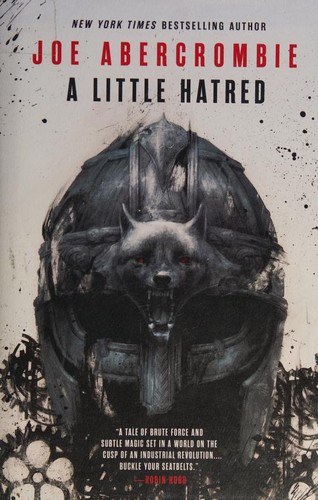
A Little Hatred by Joe Abercrombie is a 2019 fantasy book about industrialization and its human cost, class conflict, cynicism and idealism. Abercrombie maps the Industrial Revolution onto secondary-world fantasy with genuine historical engagement — the class conflict, the displacement of workers, and the revolutionary response feel researched rather than borrowed.
Summary
A Little Hatred is the first book in Abercrombie's The Age of Madness trilogy, set in the same world as his First Law trilogy but a generation later. The Circle of the World is experiencing something like an industrial revolution: factories are replacing craftsmen, machines are displacing workers, and the tensions between an entrenched aristocracy and an emerging working class are hardening into violence. The novel follows a large ensemble — soldiers, nobles, workers, scheming politicians, and the next generation of the First Law's key families — as the old world order begins to crack.
What Abercrombie is doing here is bringing grimdark fantasy into contact with recognizable historical dynamics. The Breakers are proto-revolutionary labor agitators. The Great Change is what happens when systems of power refuse to accommodate the people they're grinding up. The Union is Britain at the start of the 19th century: prosperous on paper, deeply unjust underneath. The familiar fantasy trappings — magic, swords, war — exist in a world where the defining question is who controls the new power of machines and capital, not who sits on the throne.
Abercrombie's strength is characterization under pressure. His people are complicated in ways that feel earned rather than forced: Savine dan Glokta is a fascinating figure, combining her father's strategic intelligence with a ruthless investor's eye; Leo dan Brock is brave and stupid in proportions that make him genuinely dangerous; Rikke has a gift for seeing the future that is less useful than it sounds. The violence is brutal but purposeful, and Abercrombie is careful to show what it costs. The First Law's nihilism has here become something more dialectical.
Readers who loved the First Law trilogy will find this a confident return to the world with more on its mind. Those who haven't read the earlier books can start here — the new characters are central and the callbacks reward rather than require prior knowledge. Grimdark skeptics won't be converted: Abercrombie's world remains punishing and ironic, and the industrial revolution content is not subtle. But within the genre, this is some of the most structurally intelligent fantasy being written.
Talk to A Little Hatred like its author wrote you back.
Get the ideas that fit your life — not generic summaries.
- Chat with the book
- Audiobook-style main ideas
- Adapts to your life and goals
- Helps you take action
Key takeaways
- 1.
Abercrombie maps the Industrial Revolution onto secondary-world fantasy with genuine historical engagement — the class conflict, the displacement of workers, and the revolutionary response feel researched rather than borrowed.
- 2.
Savine dan Glokta is one of the more interesting figures Abercrombie has written: a woman who plays the aristocratic game better than anyone while being fully aware of its costs.
- 3.
The novel's treatment of violence is consistent with the First Law but more politically located — the brutality here has a structural cause, not just a human one.
- 4.
Leo dan Brock is a study in how uncomplicated bravery becomes a liability in a complicated world. His arc across the trilogy is one of Abercrombie's more uncomfortable portraits.
- 5.
The magic system remains deliberately limited and morally compromised. In a world reshaping itself around industrial power, magic feels increasingly beside the point.
- 6.
Abercrombie refuses the consolation of revolution. The Breakers have legitimate grievances and some of them are genuinely admirable — and that doesn't stop things from going badly.
- 7.
The title is a line from the novel about how a little hatred is easier to sustain than large injustice. It functions as a thesis about how systems of oppression maintain themselves.
- 8.
The next generation of the original trilogy's characters are distinct from their parents, but their inheritances — literal and psychological — haunt the plot.
- 9.
Rikke's prophetic visions are handled unusually: they're genuinely useful to the plot but the book is honest about the cost of knowing what's coming.
Discussion questions
Use these on your own, with a book club, or as chat starters in Superbook. Book club version, ready to copy or print →
- 1.
Savine dan Glokta is the novel's most morally complex figure. Is she a villain, a pragmatist, or something else? Does the novel want you to like her?
- 2.
The Breakers are revolutionary agitators with legitimate grievances. Does Abercrombie make their cause sympathetic, or does he undermine it? What's his political position, do you think?
- 3.
Leo dan Brock is brave and admired and makes catastrophically bad decisions. Is the novel arguing that heroism and good judgment are simply different skills, or is it making a harsher point?
- 4.
The industrial revolution setting is unusual for fantasy. Did it work for you? Does it clarify or reduce the political arguments by making them this legible?
- 5.
The Circle of the World has a history of violent upheaval. Does the novel suggest that the current crisis is meaningfully different from the last one, or just another cycle?
- 6.
Rikke sees the future but can't change it in obvious ways. Is her power a gift or a curse — and does the novel take a position on that?
- 7.
How does this compare to the First Law trilogy's mood? Abercrombie seems angrier here, or at least more politically specific. Do you read it that way?
- 8.
The aristocratic characters — Savine, Leo, Orso — are all more sympathetic than their class interests would suggest. Is that a problem, or is it part of the point?
- 9.
The ending sets up the next two books aggressively. Did that feel satisfying as a standalone experience, or did it feel like a setup document?
- 10.
Abercrombie has talked about wanting to write about how people in power justify their self-interest with principle. Which character in this book does that most clearly?
- 11.
The Breakers are compared to Chartists, trade unionists, even early socialists. Does that mapping feel accurate? What does it gain or lose by being in a fantasy world?
- 12.
Violence in the novel is often followed by its consequences being shown in detail. Does that make the action sequences feel more or less exciting than standard fantasy?
Themes
Frequently asked questions
-
Do I need to read the First Law trilogy first?
No, though it enriches the experience. The Age of Madness focuses on a new generation of characters and the major events are explained within the text. If you haven't read the First Law, start here and go back later if the world grabs you.
-
Is A Little Hatred grimdark? I've heard that can be exhausting.
Yes, this is firmly in grimdark territory. Abercrombie's world is brutal, his characters suffer, and his irony is consistent. But A Little Hatred is arguably more politically purposeful than the First Law — the darkness has a structural argument behind it rather than being purely atmospheric.
-
What is A Little Hatred about, briefly?
An industrial revolution is tearing apart a fantasy world as factories replace craftsmen, class tensions explode into violence, and the children of the previous generation's heroes try to navigate a world their parents' actions helped break.
-
Who shouldn't read this book?
Fantasy readers who prefer moral clarity, heroic arcs, or low body counts. Also anyone who finds satire of aristocratic self-interest tedious. This is a long, cynical, politically charged fantasy novel. If that doesn't sound appealing, it won't convert you.
-
How does the trilogy end? Is it worth the investment?
The trilogy ends in The Wisdom of Crowds with Abercrombie's characteristic refusal to let anyone feel too good about what happened. It is worth the investment if you're engaged by the first book — the three volumes form a genuine arc, not just an extended story.