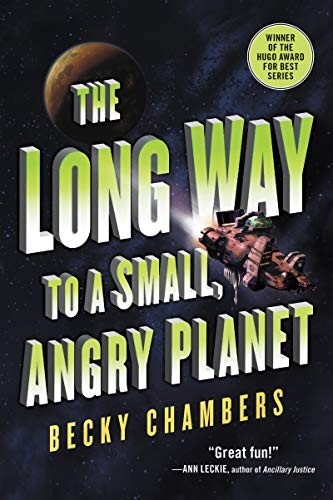
Talk to A Long Way to a Small, Angry Planet like its author wrote you back.
Get the ideas that fit your life — not generic summaries.
- Chat with the book
- Audiobook-style main ideas
- Adapts to your life and goals
- Helps you take action
A Long Way to a Small, Angry Planet, in detail
Rosemary Harper boards the Wayfarer under a false identity, hoping to escape a family history she cannot speak about. The Wayfarer is a tunneling ship — it punches wormholes through space — crewed by humans and aliens of wildly different biologies, customs, and moral frameworks. Their new contract will take them to the edge of known space to tunnel through a politically unstable region, a job that's risky but well-paid. Most of the novel is the journey there.
That description makes it sound like a plot-driven thriller, which it isn't. Chambers is far more interested in her crew than in the mission: in how Sissix, the reptilian navigator, understands physical affection completely differently than the human crew; in how Kizzy and Jenks maintain a friendship across a biological difference that's only going to grow; in what it means for Dr. Chef to be the sole surviving member of his species. Each chapter tends to focus on a crew member or pair, and the texture of the book is less narrative arc than character mosaic. The plot eventually delivers on its premise but that's not where the book lives.
Chambers writes with deliberate warmth — a quality that some readers find refreshing and others find too comfortable. She is interested in people treating each other well across difference, in forgiveness, in care as a value worth taking seriously. The aliens are genuinely alien rather than humans in rubber suits, and the cultural misunderstandings they generate are handled with curiosity rather than comedy. The book began as a self-published novel and its enthusiastic word-of-mouth following reflects the hunger for SF that is fundamentally kind without being naive.
This is the right book if you've been put off science fiction by its coldness or militarism, or if you want fiction that thinks carefully about how different kinds of beings might coexist. It's the wrong book if you want a fast-paced plot or a world in existential crisis. The stakes are personal, the scope is small by space opera standards, and that's entirely the point. The Wayfarers series continues in A Record of a Spaceborn Few and A Psalm for the Wild-Built, which are companion novels rather than direct sequels.
The big ideas
- 1.
Found family as the novel's organizing ethic: the Wayfarer crew is not bound by blood or nationality but by shared work and deliberate care, and Chambers treats this as fully sufficient.
- 2.
Alien species are written with genuine cognitive and biological specificity — Sissix's relationship to physical affection, the Grum's collective memory — rather than as human-with-differences.
- 3.
Rosemary's hidden past is a character study in how shame functions: what we conceal, why, and what it costs to keep concealing it inside a community that trusts you.
