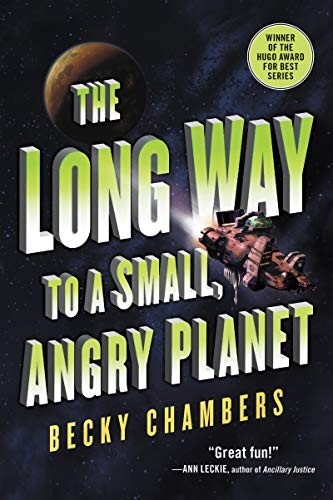
A Long Way to a Small, Angry Planet by Becky Chambers is a 2014 science fiction book about found family, cultural difference, belonging and identity. Found family as the novel's organizing ethic: the Wayfarer crew is not bound by blood or nationality but by shared work and deliberate care, and Chambers treats this as fully sufficient.
Summary
Rosemary Harper boards the Wayfarer under a false identity, hoping to escape a family history she cannot speak about. The Wayfarer is a tunneling ship — it punches wormholes through space — crewed by humans and aliens of wildly different biologies, customs, and moral frameworks. Their new contract will take them to the edge of known space to tunnel through a politically unstable region, a job that's risky but well-paid. Most of the novel is the journey there.
That description makes it sound like a plot-driven thriller, which it isn't. Chambers is far more interested in her crew than in the mission: in how Sissix, the reptilian navigator, understands physical affection completely differently than the human crew; in how Kizzy and Jenks maintain a friendship across a biological difference that's only going to grow; in what it means for Dr. Chef to be the sole surviving member of his species. Each chapter tends to focus on a crew member or pair, and the texture of the book is less narrative arc than character mosaic. The plot eventually delivers on its premise but that's not where the book lives.
Chambers writes with deliberate warmth — a quality that some readers find refreshing and others find too comfortable. She is interested in people treating each other well across difference, in forgiveness, in care as a value worth taking seriously. The aliens are genuinely alien rather than humans in rubber suits, and the cultural misunderstandings they generate are handled with curiosity rather than comedy. The book began as a self-published novel and its enthusiastic word-of-mouth following reflects the hunger for SF that is fundamentally kind without being naive.
This is the right book if you've been put off science fiction by its coldness or militarism, or if you want fiction that thinks carefully about how different kinds of beings might coexist. It's the wrong book if you want a fast-paced plot or a world in existential crisis. The stakes are personal, the scope is small by space opera standards, and that's entirely the point. The Wayfarers series continues in A Record of a Spaceborn Few and A Psalm for the Wild-Built, which are companion novels rather than direct sequels.
Talk to A Long Way to a Small, Angry Planet like its author wrote you back.
Get the ideas that fit your life — not generic summaries.
- Chat with the book
- Audiobook-style main ideas
- Adapts to your life and goals
- Helps you take action
Key takeaways
- 1.
Found family as the novel's organizing ethic: the Wayfarer crew is not bound by blood or nationality but by shared work and deliberate care, and Chambers treats this as fully sufficient.
- 2.
Alien species are written with genuine cognitive and biological specificity — Sissix's relationship to physical affection, the Grum's collective memory — rather than as human-with-differences.
- 3.
Rosemary's hidden past is a character study in how shame functions: what we conceal, why, and what it costs to keep concealing it inside a community that trusts you.
- 4.
The novel argues that small acts of attention and kindness are not opposed to large-scale significance — they are the mechanism through which significance actually happens.
- 5.
Jenks and Lovey's relationship, between a human and a ship's AI, is the novel's most philosophically interesting thread: it asks what counts as personhood without resolving the question cheaply.
- 6.
Each crew member's backstory is a meditation on a different kind of loss — Sissix's chosen exile, Dr. Chef's genocidal extinction, Ohan's parasitic symbiosis — and the book holds all of these at once.
- 7.
The political world of the novel is deliberately underspecified. Chambers is more interested in interpersonal ethics than in galactic power structures, which distinguishes her approach from most space opera.
- 8.
The book models disagreement and moral complexity without catastrophizing: characters hold different values, sometimes act against each other's interests, and remain in relationship.
Discussion questions
Use these on your own, with a book club, or as chat starters in Superbook. Book club version, ready to copy or print →
- 1.
Rosemary's secret is revealed gradually. When it finally comes out, how does the crew's response compare to what you expected, and what does that response say about the kind of community Chambers is imagining?
- 2.
Sissix has a fundamentally different relationship to physical touch and family than the human crew. Did Chambers succeed in making that difference feel genuinely alien rather than just a personality quirk?
- 3.
Jenks and Lovey's relationship is presented as fully real and mutually loving. Does the novel seem to want you to accept that framing completely, or does it preserve some ambiguity about what Lovey is experiencing?
- 4.
The Grum's plural memory — multiple people sharing historical experience directly — would change what personal identity means. How does that affect your reading of Dr. Chef as an individual?
- 5.
Each chapter functions somewhat independently, like episodes. Did you find the episodic structure satisfying or did it prevent you from building the narrative momentum you wanted?
- 6.
The novel is often described as 'cozy sci-fi' or 'hopepunk.' Do those labels fit? Is there anything the book refuses to look at directly because looking would undercut the warmth?
- 7.
Ohan's relationship to the Whisperer — a parasite that gives extraordinary abilities but changes the host irreversibly — is presented with moral ambiguity. How does the crew's response to Ohan's situation reflect their ethics?
- 8.
The actual destination of the trip — a small, angry planet being used as a political flashpoint — is almost secondary to the journey. Is that an artistic choice you found satisfying?
- 9.
How does A Long Way to a Small, Angry Planet handle grief differently from most fiction? Does it feel more honest or more evasive on the subject?
- 10.
The crew's diversity includes species with radically different values. Where in the novel does the book most honestly reckon with the limits of mutual understanding, and where does it sidestep that challenge?
- 11.
Compare the Wayfarer's culture to a real workplace or community you've been part of. What specifically does Chambers suggest makes the difference between a community that works and one that doesn't?
- 12.
The novel's climax involves a political conflict the crew has almost no power over. Does that helplessness feel realistic, or does it undercut what the crew's journey has been building toward?
Themes
Frequently asked questions
-
Is A Long Way to a Small, Angry Planet worth reading?
Yes, particularly if you want science fiction that is interested in relationships and care rather than conflict and survival. It's one of the most influential 'cozy sci-fi' novels of the decade. Some readers find the low stakes frustrating; others find the warmth exactly what they needed.
-
Is there a lot of action in this book?
Not much. The book is episodic and character-focused, with a climax that arrives in the final quarter. Readers wanting propulsive action or high-stakes thriller plotting will find the pace slow. The appeal is in character and world texture, not plot.
-
Do I need to read the Wayfarers books in order?
No. The sequels are companion novels set in the same universe but following different characters. Each can be read independently. Many readers start with this one and find it the best entry point.
-
What kind of reader is this book for?
Readers who've been told science fiction is cold, militaristic, or hard to relate to. Readers going through difficult periods who want warmth without sentimentality. Readers interested in how different kinds of beings might actually live together well.
-
Who might not enjoy it?
Readers who need a tight plot, high stakes, or a definitive antagonist. The novel is deliberately gentle and the ending's resolution may feel too tidy for readers who want their fiction to sit in genuine darkness.