Talk to A Pattern Language like its author wrote you back.
Get the ideas that fit your life — not generic summaries.
- Chat with the book
- Audiobook-style main ideas
- Adapts to your life and goals
- Helps you take action
What it argues
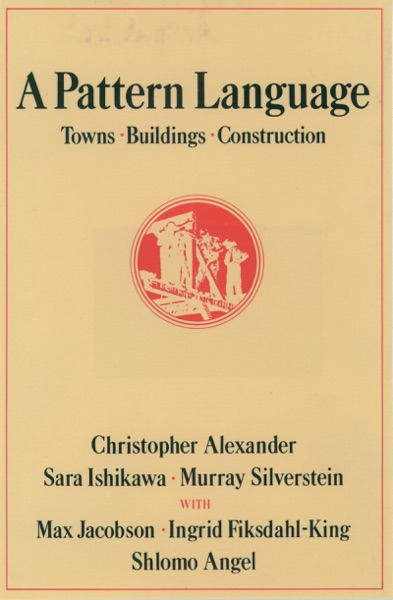
A Pattern Language is an extraordinary attempt to describe, in systematic form, the conditions that make human habitats feel alive. Christopher Alexander, Sara Ishikawa, and Murray Silverstein identified 253 patterns — recurring solutions to recurring design problems — spanning scales from regional planning down to the details of window seats and ceiling heights. The book is organized so that each pattern connects to others above and below it in scale, creating an interlocking language that anyone, not just architects, can use to understand and shape their environment.
The patterns themselves range from the broad ("distribution of towns," "mosaic of subcultures") to the intimate ("child caves," "alcoves," "window place"). Each follows the same format: a statement of the problem, evidence from research and observation, the solution, and links to related patterns. Alexander's evidence draws on anthropology, behavioral science, historical architecture, and direct observation of places people find genuinely habitable versus merely functional. The implicit argument throughout is that modernist design has systematically produced environments that fail human needs, not because architects are incompetent but because they are working from the wrong assumptions.
What it gets right
- 1.
Good design is not invented but discovered — patterns that recur across successful environments across cultures and centuries represent accumulated human knowledge about what works.
- 2.
Scale matters: a building cannot be good if it sits on a bad street, and a street cannot be good if it belongs to a poorly structured neighborhood. The patterns are hierarchical and interdependent.
- 3.
Modernist planning systematically removed the features — mixed uses, permeable edges, human-scale streets — that make urban environments feel alive, and replaced them with abstraction.
What it covers
Who wrote it
Christopher Alexander (1936–2022) was an Austrian-born British-American architect and design theorist. He spent most of his career at the University of California, Berkeley, where he was a professor of architecture for decades. His other major works include The Timeless Way of Building, Notes on the Synthesis of Form, and the four-volume The Nature of Order. Alexander was among the most influential design thinkers of the twentieth century, and his concept of patterns directly inspired the software engineering design pattern movement of the 1990s. His built work includes housing projects in Mexico, Japan, and the United States.
