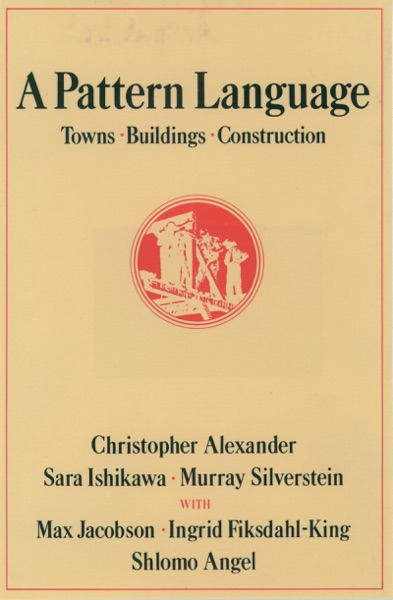
A Pattern Language by Christopher Alexander is a 1977 science book about architecture, urban design, human-centered design. Good design is not invented but discovered — patterns that recur across successful environments across cultures and centuries represent accumulated human knowledge about what works.
Summary
A Pattern Language is an extraordinary attempt to describe, in systematic form, the conditions that make human habitats feel alive. Christopher Alexander, Sara Ishikawa, and Murray Silverstein identified 253 patterns — recurring solutions to recurring design problems — spanning scales from regional planning down to the details of window seats and ceiling heights. The book is organized so that each pattern connects to others above and below it in scale, creating an interlocking language that anyone, not just architects, can use to understand and shape their environment.
The patterns themselves range from the broad ("distribution of towns," "mosaic of subcultures") to the intimate ("child caves," "alcoves," "window place"). Each follows the same format: a statement of the problem, evidence from research and observation, the solution, and links to related patterns. Alexander's evidence draws on anthropology, behavioral science, historical architecture, and direct observation of places people find genuinely habitable versus merely functional. The implicit argument throughout is that modernist design has systematically produced environments that fail human needs, not because architects are incompetent but because they are working from the wrong assumptions.
The theoretical core, spelled out more fully in Alexander's companion volume The Timeless Way of Building, is that living environments share a quality he refuses to name directly — something like vitality or rightness — that emerges from the correct application of patterns that have been discovered, not invented. The book is therefore both a practical manual and a philosophical argument about what design is for.
Reading the full 1,200-page text straight through is not the right approach. Most readers dip into it, follow the connections between patterns, and find themselves reading for an hour when they only meant to look up one thing. The book rewards this kind of non-linear reading. It has influenced architects, urban planners, software engineers (who adapted Alexander's pattern concept to produce design patterns in code), and anyone who has wondered why certain streets, courtyards, or rooms feel profoundly comfortable while others do not.
Talk to A Pattern Language like its author wrote you back.
Get the ideas that fit your life — not generic summaries.
- Chat with the book
- Audiobook-style main ideas
- Adapts to your life and goals
- Helps you take action
Key takeaways
- 1.
Good design is not invented but discovered — patterns that recur across successful environments across cultures and centuries represent accumulated human knowledge about what works.
- 2.
Scale matters: a building cannot be good if it sits on a bad street, and a street cannot be good if it belongs to a poorly structured neighborhood. The patterns are hierarchical and interdependent.
- 3.
Modernist planning systematically removed the features — mixed uses, permeable edges, human-scale streets — that make urban environments feel alive, and replaced them with abstraction.
- 4.
The pattern format (problem, evidence, solution) makes design knowledge transmissible to non-experts. Patterns are meant to be understood and used by the people who will live with the results.
- 5.
Natural light, visible sky, connection to the outdoors, and human-scale proportions are not aesthetic preferences but fundamental requirements for psychological comfort in built environments.
- 6.
Transitions matter. Thresholds between public and private space, between street and home, between rooms, shape how people feel and behave. Abrupt transitions are almost always wrong.
- 7.
The software concept of design patterns derives directly from Alexander. The same idea — reusable solutions to recurring problems — transferred from architecture to code in the 1990s and changed how programmers think about structure.
- 8.
A pattern language is generative: combining patterns produces an infinite variety of specific buildings and places, rather than prescribing a single correct form.
Discussion questions
Use these on your own, with a book club, or as chat starters in Superbook. Book club version, ready to copy or print →
- 1.
Alexander argues that modernist architecture has been systematically wrong about human needs. Do you find this persuasive? What examples from your own environment support or challenge it?
- 2.
The book claims patterns can be discovered rather than invented. What would it mean for a design principle to be objectively true across cultures?
- 3.
Pick a space you find deeply comfortable — a room, a café, a street — and try to identify which patterns from the book it instantiates. What does that exercise reveal?
- 4.
Alexander says the quality he is describing cannot be named directly. Do you think that is a conceptual gap or a genuine feature of the thing being described?
- 5.
The book was designed to be used by non-architects to shape their own environments. Has professional design expertise made buildings better or worse for the people who inhabit them?
- 6.
Software design patterns borrowed Alexander's concept. Do you think the transfer works? What is preserved and what is lost when the idea moves from physical space to code?
- 7.
Which of the 253 patterns do you find most surprising or counterintuitive? Which feels most obviously right?
- 8.
The book implies that certain environments are better for human beings independent of cultural preference. Is that claim defensible, or is 'what makes a space good' entirely relative?
- 9.
Alexander's patterns describe what has worked historically. Does that make the book conservative? Can it accommodate genuinely new types of living and working?
- 10.
If you could apply three patterns from the book to a space you currently inhabit — home, office, neighborhood — which would you choose and why?
- 11.
The book runs to over 1,000 pages. Does its size and density make it more or less useful than a shorter, more prescriptive design guide?
- 12.
How does the idea of a 'language' of patterns change your understanding of what design is? What does the metaphor get right and what does it get wrong?
Themes
Frequently asked questions
-
Do I need to read all 1,200 pages of A Pattern Language?
No. The book is designed for non-linear use. Most readers find a pattern that interests them, follow its connections to related patterns, and navigate freely. Reading the introduction and a dozen patterns relevant to your life is a complete and rewarding experience.
-
Is A Pattern Language still relevant today?
Yes, probably more than ever. The problems Alexander describes — placeless sprawl, alienating open offices, streets hostile to pedestrians — have intensified since 1977. The patterns themselves hold up better than most design theory from the same period.
-
What is the connection between A Pattern Language and software design patterns?
The Gang of Four (Gamma, Helm, Johnson, Vlissides) explicitly credited Alexander when they introduced design patterns to software engineering in their 1994 book Design Patterns. The core idea — reusable solutions to recurring problems, named and documented — transferred almost directly from architecture to code.
-
Who should read this book?
Architects and urban planners obviously, but also anyone who has wondered why certain places feel right and others feel wrong: software engineers, product designers, city residents engaged with their neighborhoods, homeowners renovating a space. The book's real audience is anyone who shapes environments for other people.
-
What is Alexander's main criticism of modernist architecture?
That it optimized for abstraction, efficiency, and visual novelty rather than for the accumulated patterns that make environments feel alive to the humans who inhabit them. The result was buildings and cities that looked interesting in photographs but were uncomfortable to actually live in.
Similar books
Making and Breaking the Grid
Timothy Samara
The New Typography
Jan Tschichold
The Elements of User Experience
Jesse James Garrett
Abstract Painting: Concepts and Techniques
Valérie Filiou
