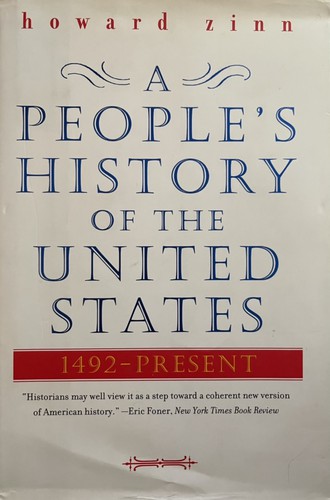
Talk to A People's History of the United States like its author wrote you back.
Get the ideas that fit your life — not generic summaries.
- Chat with the book
- Audiobook-style main ideas
- Adapts to your life and goals
- Helps you take action
What it argues
Howard Zinn's A People's History of the United States, first published in 1980, retells American history from the perspective of those who rarely appear in conventional textbooks: Native Americans, enslaved people, industrial workers, women, immigrants, and dissidents of various kinds. Zinn was explicit about his method — he was not attempting a neutral account but a corrective one, using the historical record to show what gets left out when history is written from the perspective of the powerful.
The book begins with Columbus's arrival in the Americas and the destruction of indigenous populations, and proceeds through the Revolutionary War, industrialization, the labor movement, the two world wars, the civil rights era, Vietnam, and beyond. In each chapter, Zinn focuses on the people who resisted or suffered under the prevailing order rather than those who directed it. The Founding Fathers appear not as visionary democrats but as property-owning elites managing a revolution that preserved their position. The labor movement gets more attention than most wars. The treatment of Black Americans, women, and the poor is sustained throughout rather than confined to dedicated chapters.
What it gets right
- 1.
All historical accounts involve selection, and the selection in standard American history has systematically privileged the perspectives of the powerful over those of workers, minorities, women, and dissidents.
- 2.
The American Revolution was not simply a democratic uprising but also a movement by colonial elites to consolidate their power, and many of those it claimed to liberate remained enslaved, dispossessed, or excluded.
- 3.
Slavery was not a regional aberration but a fundamental economic institution whose profits built Northern as well as Southern prosperity, and whose legacy structured American capitalism for generations.
What it covers
Who wrote it
Howard Zinn (1922–2010) was an American historian, playwright, and activist. He taught political science at Boston University from 1964 to 1988 and was a prominent participant in the civil rights and antiwar movements. His other works include SNCC: The New Abolitionists and The Zinn Reader. A People's History, first published in 1980 and updated through several editions, has sold more than three million copies and remains widely assigned in American high schools and universities despite persistent controversy over its methodology and perspective.
