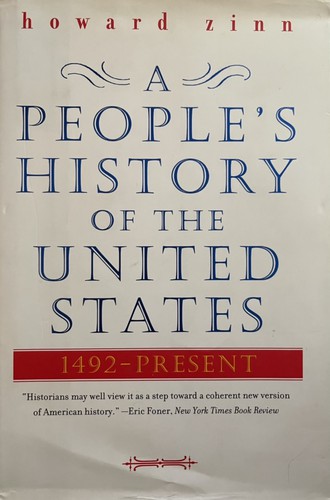
A People's History of the United States by Howard Zinn is a 1980 history book about american history, class conflict, social movements. All historical accounts involve selection, and the selection in standard American history has systematically privileged the perspectives of the powerful over those of workers, minorities, women, and dissidents.
Summary
Howard Zinn's A People's History of the United States, first published in 1980, retells American history from the perspective of those who rarely appear in conventional textbooks: Native Americans, enslaved people, industrial workers, women, immigrants, and dissidents of various kinds. Zinn was explicit about his method — he was not attempting a neutral account but a corrective one, using the historical record to show what gets left out when history is written from the perspective of the powerful.
The book begins with Columbus's arrival in the Americas and the destruction of indigenous populations, and proceeds through the Revolutionary War, industrialization, the labor movement, the two world wars, the civil rights era, Vietnam, and beyond. In each chapter, Zinn focuses on the people who resisted or suffered under the prevailing order rather than those who directed it. The Founding Fathers appear not as visionary democrats but as property-owning elites managing a revolution that preserved their position. The labor movement gets more attention than most wars. The treatment of Black Americans, women, and the poor is sustained throughout rather than confined to dedicated chapters.
Zinn's method is unapologetically selective. He acknowledges he is telling one side of the story, on the grounds that the other side already occupies the standard curriculum. The result is a genuinely useful corrective to hagiographic national history, but it is also a book with blind spots of its own — the voices Zinn elevates are real, but the analysis is often schematic, reducing complex historical causation to patterns of class interest and elite manipulation.
For all its limitations, it became one of the best-selling history books in American publishing history. Its influence on how Americans think about their own history — particularly among people who first encountered it as students — is difficult to overstate. Read alongside more conventional accounts, it functions as a necessary disruption to comfortable narratives. Read alone, it can give a distorted picture. The most honest assessment is that Zinn changed the questions his readers thought to ask, which is no small thing.
Talk to A People's History of the United States like its author wrote you back.
Get the ideas that fit your life — not generic summaries.
- Chat with the book
- Audiobook-style main ideas
- Adapts to your life and goals
- Helps you take action
Key takeaways
- 1.
All historical accounts involve selection, and the selection in standard American history has systematically privileged the perspectives of the powerful over those of workers, minorities, women, and dissidents.
- 2.
The American Revolution was not simply a democratic uprising but also a movement by colonial elites to consolidate their power, and many of those it claimed to liberate remained enslaved, dispossessed, or excluded.
- 3.
Slavery was not a regional aberration but a fundamental economic institution whose profits built Northern as well as Southern prosperity, and whose legacy structured American capitalism for generations.
- 4.
The labor movement of the late nineteenth and early twentieth centuries achieved the eight-hour day, child labor laws, and workplace safety through organized struggle that was often met with state and private violence.
- 5.
American wars — including World War I, Vietnam, and others — were consistently supported by ruling-class interests and sold to working-class populations through propaganda, despite the costs being borne disproportionately by those at the bottom.
- 6.
Women's suffrage, civil rights, and antiwar movements succeeded not primarily through the goodwill of those in power but through sustained organized resistance that made the status quo politically untenable.
- 7.
The consent of the governed is largely manufactured through control of media, education, and the terms of political debate — a point Zinn draws from Noam Chomsky and illustrates throughout the book.
- 8.
History written from below does not simply add new information — it changes the interpretation of events that seemed settled, revealing how standard narratives naturalize arrangements that were contested and contingent.
Discussion questions
Use these on your own, with a book club, or as chat starters in Superbook. Book club version, ready to copy or print →
- 1.
Zinn openly states he is telling a partial story. Does acknowledging bias make a historical account more or less trustworthy than one that claims neutrality?
- 2.
Which chapter in the book most changed how you thought about an event or period you thought you already understood?
- 3.
Zinn gives the labor movement far more attention than it receives in most American history curricula. What does that rebalancing reveal, and what does it obscure?
- 4.
How do you assess the book's treatment of the Founding Fathers? Is the critique that they were property-protecting elites compatible with the genuine importance of the constitutional framework they created?
- 5.
Zinn's method relies heavily on the concept of class interest as an explanatory tool. When does that framework illuminate historical causation, and when does it simplify it?
- 6.
The book was written in 1980. Which parts feel most dated, and which remain directly relevant to current political debates?
- 7.
Zinn argues that meaningful change in American history has come primarily from organized movements rather than from enlightened leadership. Does the historical evidence support that claim?
- 8.
What does it mean to write history 'from below'? What sources does that approach rely on, and what are its methodological limits?
- 9.
The book has been both celebrated and criticized for its use in American classrooms. What do you think is gained and lost when students read it as an introduction to American history rather than as a corrective to it?
- 10.
How does Zinn's account of American foreign policy — particularly in Latin America and Southeast Asia — compare to what you knew before reading it?
- 11.
Which group's story did you find most effectively told in the book? Which felt most incomplete?
- 12.
If you were assigning this book alongside one other history of the United States, which book would you choose to put in conversation with it?
Themes
Frequently asked questions
-
Is A People's History of the United States historically accurate?
The individual facts Zinn cites are generally well-sourced, but his interpretive framework is consciously one-sided. Historians across the political spectrum have criticized his tendency to reduce complex causation to class conflict and to downplay or omit evidence that complicates his narrative.
-
Is A People's History appropriate for high school students?
It depends on how it's used. As a corrective read alongside more conventional accounts, it develops critical thinking about historical perspective and power. As a sole textbook, it risks replacing one partial account with another. Most educators who assign it use it as a debate-generating primary text.
-
What is the main argument of A People's History?
That standard American history is told from the perspective of those who won — political and economic elites — and that retelling it from the perspective of workers, slaves, indigenous peoples, women, and dissidents reveals a different and more complete picture of how power has operated and been resisted.
-
How long does it take to read A People's History?
The full book runs about 700 pages and takes 15 to 20 hours. The chapters are largely self-contained and cover distinct periods, so it can be read selectively by period or theme without losing the argument.
-
Who should read A People's History of the United States?
Anyone who wants to understand the American left's historical framework and the arguments for centering marginalized voices in national history. It is essential context for debates about how American history is taught, and valuable for anyone whose prior education was dominated by a more triumphalist narrative.