Talk to A People's History of the United States like its author wrote you back.
Get the ideas that fit your life — not generic summaries.
- Chat with the book
- Audiobook-style main ideas
- Adapts to your life and goals
- Helps you take action
A People's History of the United States, in detail
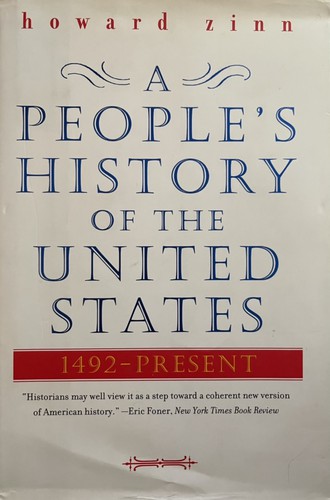
Howard Zinn's A People's History of the United States, first published in 1980, retells American history from the perspective of those who rarely appear in conventional textbooks: Native Americans, enslaved people, industrial workers, women, immigrants, and dissidents of various kinds. Zinn was explicit about his method — he was not attempting a neutral account but a corrective one, using the historical record to show what gets left out when history is written from the perspective of the powerful.
The book begins with Columbus's arrival in the Americas and the destruction of indigenous populations, and proceeds through the Revolutionary War, industrialization, the labor movement, the two world wars, the civil rights era, Vietnam, and beyond. In each chapter, Zinn focuses on the people who resisted or suffered under the prevailing order rather than those who directed it. The Founding Fathers appear not as visionary democrats but as property-owning elites managing a revolution that preserved their position. The labor movement gets more attention than most wars. The treatment of Black Americans, women, and the poor is sustained throughout rather than confined to dedicated chapters.
Zinn's method is unapologetically selective. He acknowledges he is telling one side of the story, on the grounds that the other side already occupies the standard curriculum. The result is a genuinely useful corrective to hagiographic national history, but it is also a book with blind spots of its own — the voices Zinn elevates are real, but the analysis is often schematic, reducing complex historical causation to patterns of class interest and elite manipulation.
For all its limitations, it became one of the best-selling history books in American publishing history. Its influence on how Americans think about their own history — particularly among people who first encountered it as students — is difficult to overstate. Read alongside more conventional accounts, it functions as a necessary disruption to comfortable narratives. Read alone, it can give a distorted picture. The most honest assessment is that Zinn changed the questions his readers thought to ask, which is no small thing.
The big ideas
- 1.
All historical accounts involve selection, and the selection in standard American history has systematically privileged the perspectives of the powerful over those of workers, minorities, women, and dissidents.
- 2.
The American Revolution was not simply a democratic uprising but also a movement by colonial elites to consolidate their power, and many of those it claimed to liberate remained enslaved, dispossessed, or excluded.
- 3.
Slavery was not a regional aberration but a fundamental economic institution whose profits built Northern as well as Southern prosperity, and whose legacy structured American capitalism for generations.
