Historical fiction · Book club
A Tale of Two Cities book club questions
Here are 12 book club questions for A Tale of Two Cities by Charles Dickens, ordered to open easily and end somewhere worth arguing about. Copy them, print them, or bring them up one at a time.
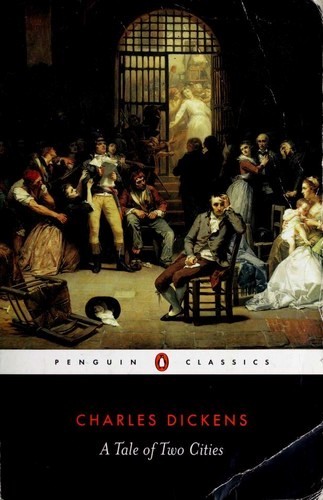
A Tale of Two Cities is set against the French Revolution and follows three intertwined characters: Charles Darnay, a French aristocrat who has renounced his title and family legacy; Lucie Manette, the daughter of a man who spent eighteen years imprisoned in the Bastille; and Sydney Carton, a dissolute English lawyer who loves Lucie without hope and knows he will never be the man Darnay already is.
Charles Dickens · 1859 · 9h 0m
Full summary and key takeaways →The 12 questions
- 1.
Dickens presents the aristocracy and the revolutionary mob as mirror images of each other's cruelty. Is that a historical argument or a political evasion?
- 2.
Sydney Carton describes himself as having no future. Is his sacrifice an act of genuine love or a convenient exit from a life he'd already given up on?
- 3.
Madame Defarge has suffered real injustice. At what point, if any, does the novel suggest her methods stop being justified?
- 4.
The famous opening — 'It was the best of times, it was the worst of times' — is a trick: Dickens is describing both the 1790s and the 1850s. What does that doubled frame do?
- 5.
Dr. Manette regresses to cobbling under stress throughout the novel. How does Dickens use this as a device for showing trauma? Does it feel credible?
- 6.
The novel depends on a series of coincidences that strain credulity. Does that undermine its emotional power or is it part of the genre contract?
- 7.
Lucie Manette is largely passive compared to the male characters around her. Is she a weakness in the novel or does she serve a function Dickens needs?
- 8.
The ending is often taught as an act of pure selflessness. Is there anything in Carton's character that complicates that reading?
- 9.
Dickens was personally sympathetic to some radical politics but deeply hostile to mob violence. How does that tension play out in the novel?
- 10.
Compare Dickens's French Revolution to Hilary Mantel's treatment of revolution in Wolf Hall. What does historical fiction gain and lose by taking sides?
- 11.
The Marquis St. Evrémonde tosses a coin after killing a child and rides on. What does this scene establish, and does the novel follow through on what it promises?
- 12.
The novel's title pairs London and Paris — but are they actually equivalent? What does Dickens think of England by 1859?
How to run the discussion
- Pick six to eight, not all of them. An hour of real discussion covers fewer questions than anyone expects, and racing the list is what makes a book club feel like homework.
- Open with what people noticed, not what they concluded. Asking for a verdict first hardens opinions before anyone has heard each other.
- Let the disagreement run. The questions below that split a room are the ones worth the time; the ones everyone answers the same way can be skipped.
- Ask the quiet person a specific question. A direct, narrow question is far easier to answer than an open invitation to contribute.
Themes worth steering toward
If the conversation stalls, these are the threads that usually restart it.
Common questions
What are good book club questions for A Tale of Two Cities?
Here are 12 book club questions for A Tale of Two Cities by Charles Dickens, ordered to open easily and end somewhere worth arguing about. The strongest openers ask what each reader noticed rather than what they concluded, and the discussion usually turns on revolution and violence, sacrifice and redemption, resurrection.
How long should a book club discussion of A Tale of Two Cities last?
Most groups run 60 to 90 minutes of actual discussion. That is roughly six to eight questions, not all of them, so pick the ones that suit your group rather than working down the list in order.
What are the main themes in A Tale of Two Cities?
Revolution and violence, Sacrifice and redemption, Resurrection, Class and injustice, Doubles and duality. Those are the threads most likely to divide a room, which makes them the useful places to steer a discussion that has gone quiet.
Picking the next one? See books like A Tale of Two Cities or questions for other book club picks.
