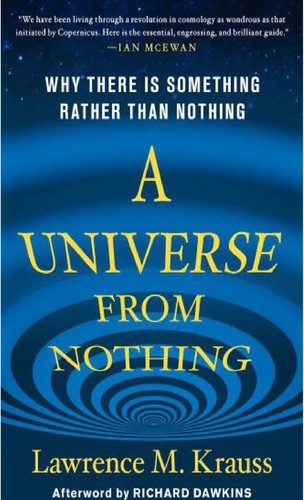
Talk to A Universe from Nothing like its author wrote you back.
Get the ideas that fit your life — not generic summaries.
- Chat with the book
- Audiobook-style main ideas
- Adapts to your life and goals
- Helps you take action
What it argues
A Universe from Nothing is Lawrence Krauss's argument that modern physics has resolved, or at least reframed, the ancient philosophical question of why there is something rather than nothing. The book grew out of a lecture Krauss gave that became one of the most-watched science videos online, and extends that argument with more technical detail and a more explicit engagement with religion and philosophy.
Krauss's physics argument proceeds in stages. First, quantum field theory describes the vacuum not as empty space but as a seething foam of virtual particles constantly appearing and annihilating. This quantum vacuum has energy — dark energy — which observations confirm is driving the accelerating expansion of the universe. Second, inflationary cosmology proposes that the universe began as a quantum fluctuation that expanded exponentially; the total energy of the observable universe is close to zero when you balance the positive energy of matter and radiation against the negative energy of gravity. The universe, in this sense, emerged from a quantum event in which the net energy cost was essentially nothing.
What it gets right
- 1.
The quantum vacuum is not empty: it contains virtual particles, fluctuating fields, and energy. 'Nothing' in quantum field theory means something very different from 'nothing' in everyday speech.
- 2.
Dark energy — the energy of empty space driving the universe's accelerating expansion — was discovered in 1998 and is one of the most puzzling observations in modern cosmology.
- 3.
The total energy of the observable universe may be approximately zero when positive matter energy is balanced against negative gravitational energy — consistent with the universe arising from a zero-energy quantum fluctuation.
What it covers
Who wrote it
Lawrence M. Krauss is a theoretical physicist and cosmologist who was a professor at Arizona State University for many years. His research has focused on dark energy, the cosmological constant problem, and the early universe. He is the author of numerous popular science books including The Physics of Star Trek, Quantum Man (a biography of Feynman), and The Greatest Story Ever Told — So Far. Krauss was a prominent science communicator and advocate for science education. His public career was interrupted by serious misconduct allegations reported in 2018, which he has denied; he resigned from his position at ASU.
