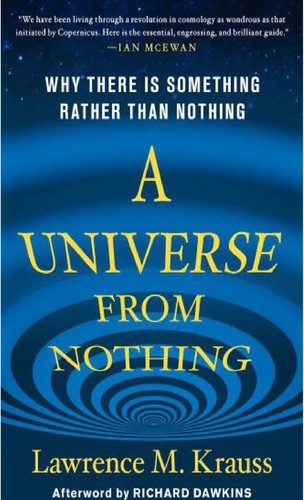
A Universe from Nothing by Lawrence M. Krauss is a 2012 science book about cosmology, quantum physics, origin of universe. The quantum vacuum is not empty: it contains virtual particles, fluctuating fields, and energy. 'Nothing' in quantum field theory means something very different from 'nothing' in everyday speech.
Summary
A Universe from Nothing is Lawrence Krauss's argument that modern physics has resolved, or at least reframed, the ancient philosophical question of why there is something rather than nothing. The book grew out of a lecture Krauss gave that became one of the most-watched science videos online, and extends that argument with more technical detail and a more explicit engagement with religion and philosophy.
Krauss's physics argument proceeds in stages. First, quantum field theory describes the vacuum not as empty space but as a seething foam of virtual particles constantly appearing and annihilating. This quantum vacuum has energy — dark energy — which observations confirm is driving the accelerating expansion of the universe. Second, inflationary cosmology proposes that the universe began as a quantum fluctuation that expanded exponentially; the total energy of the observable universe is close to zero when you balance the positive energy of matter and radiation against the negative energy of gravity. The universe, in this sense, emerged from a quantum event in which the net energy cost was essentially nothing.
Third, and most controversially, Krauss argues that quantum gravity theories suggest that space and time themselves can emerge from "nothing" — where nothing means a state with no matter, no energy, and no fixed spacetime. If the laws of physics can give rise to universes from this kind of quantum nothing, then the traditional demand for a first cause or creator becomes, at minimum, scientifically well-defined rather than purely philosophical.
The book was criticized by philosophers — most prominently by David Albert in The New York Times — for conflating physical "nothing" (the quantum vacuum) with philosophical "nothing" (the complete absence of anything, including physical laws). Krauss's response was combative. The dispute highlights a genuine tension between physics and philosophy about what it would mean to explain the origin of existence.
Talk to A Universe from Nothing like its author wrote you back.
Get the ideas that fit your life — not generic summaries.
- Chat with the book
- Audiobook-style main ideas
- Adapts to your life and goals
- Helps you take action
Key takeaways
- 1.
The quantum vacuum is not empty: it contains virtual particles, fluctuating fields, and energy. 'Nothing' in quantum field theory means something very different from 'nothing' in everyday speech.
- 2.
Dark energy — the energy of empty space driving the universe's accelerating expansion — was discovered in 1998 and is one of the most puzzling observations in modern cosmology.
- 3.
The total energy of the observable universe may be approximately zero when positive matter energy is balanced against negative gravitational energy — consistent with the universe arising from a zero-energy quantum fluctuation.
- 4.
Inflationary cosmology proposes that a brief period of exponential expansion in the early universe explains why the cosmos is so uniform, flat, and large. The quantum fluctuations during inflation produced the density variations that grew into galaxies.
- 5.
Multiverse theories — the idea that our universe is one of many — arise naturally from inflation and from string theory. If there are many universes with different physical constants, the anthropic principle explains why we observe one compatible with life.
- 6.
Modern physics has shifted the question 'why is there something rather than nothing' from a purely philosophical one to at least partly an empirical one, with specific proposals that can in principle be tested.
- 7.
The ultimate laws of physics — quantum mechanics, general relativity — also require explanation. Krauss acknowledges that asking 'where did the laws come from' pushes the question back rather than answering it.
- 8.
The history of science repeatedly shows that what seems to be a metaphysical question becomes a scientific one as understanding advances. The origin of the universe may be the latest example.
Discussion questions
Use these on your own, with a book club, or as chat starters in Superbook. Book club version, ready to copy or print →
- 1.
Is the quantum vacuum really 'nothing'? What would count as a satisfying answer to why there is something rather than nothing?
- 2.
Krauss and David Albert disagreed sharply about whether the book actually answers the philosophical question. Whose position do you find more persuasive?
- 3.
Does the multiverse concept — many universes with different physical laws — change the apparent fine-tuning of our universe, or does it just push the problem back?
- 4.
Krauss is explicitly atheist and the book is partly an argument that physics undercuts the need for a creator. Does that framing help or hurt the scientific argument?
- 5.
What does it mean for the universe to have begun as a quantum fluctuation if there was no spacetime before the fluctuation?
- 6.
Inflation solves several cosmological puzzles but has not been directly confirmed. How much should we trust a theory that solves problems without direct observational evidence?
- 7.
The accelerating expansion of the universe due to dark energy means galaxies beyond a certain distance are moving away faster than light. What does that imply for the long-term fate of the universe?
- 8.
If the laws of physics can explain the origin of the universe, what explains the laws of physics?
- 9.
Krauss argues that asking where the laws come from is a category error similar to asking what was before time. Does that seem like a satisfying response or an evasion?
- 10.
Dark energy makes up about 68% of the universe but is completely mysterious. Does the dominance of unknown components in the universe make you more or less confident in cosmological models?
- 11.
How does the book change how you think about creation narratives — religious or philosophical — that seek to explain the origin of existence?
Themes
Frequently asked questions
-
Does the book actually prove the universe came from nothing?
It provides a physics framework in which the universe could have originated from a quantum fluctuation with net zero energy. Whether that framework addresses the philosophical question of why there is something rather than nothing is disputed. Philosophers argue that quantum fields and laws of physics are themselves 'something' that requires explanation.
-
What is dark energy?
Dark energy is the label given to the unknown source of energy causing the universe's expansion to accelerate. It makes up about 68% of the total energy content of the universe but its nature is completely unknown. It may be the energy of empty space — the cosmological constant Einstein originally introduced and then abandoned.
-
How does this book compare to A Brief History of Time?
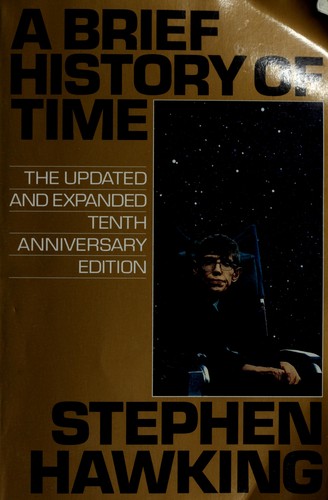
Hawking's book is broader and more accessible, covering the full history of cosmology. Krauss's book is more focused on the specific question of cosmic origins and more explicit in its philosophical and atheistic implications. Both require no prior physics background.
-
What is the controversy with David Albert?
Albert, a philosopher of physics, argued in The New York Times that Krauss conflates the quantum vacuum — a specific physical state governed by known laws — with 'nothing' in the philosophical sense. Krauss responded dismissively, which generated further controversy. The dispute reflects a real disagreement about whether physics can address philosophical questions.
-
Who should read A Universe from Nothing?
People curious about cosmology and the origin of the universe, particularly those interested in how modern physics bears on philosophical and religious questions. The book is accessible, short, and provocative — good for starting a conversation rather than settling one.