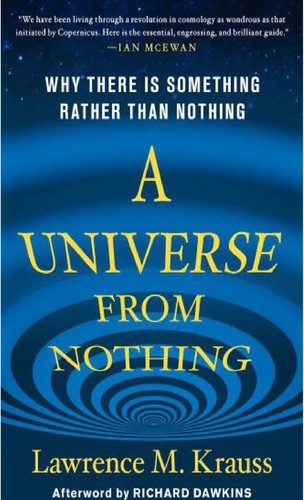
Talk to A Universe from Nothing like its author wrote you back.
Get the ideas that fit your life — not generic summaries.
- Chat with the book
- Audiobook-style main ideas
- Adapts to your life and goals
- Helps you take action
A Universe from Nothing, in detail
A Universe from Nothing is Lawrence Krauss's argument that modern physics has resolved, or at least reframed, the ancient philosophical question of why there is something rather than nothing. The book grew out of a lecture Krauss gave that became one of the most-watched science videos online, and extends that argument with more technical detail and a more explicit engagement with religion and philosophy.
Krauss's physics argument proceeds in stages. First, quantum field theory describes the vacuum not as empty space but as a seething foam of virtual particles constantly appearing and annihilating. This quantum vacuum has energy — dark energy — which observations confirm is driving the accelerating expansion of the universe. Second, inflationary cosmology proposes that the universe began as a quantum fluctuation that expanded exponentially; the total energy of the observable universe is close to zero when you balance the positive energy of matter and radiation against the negative energy of gravity. The universe, in this sense, emerged from a quantum event in which the net energy cost was essentially nothing.
Third, and most controversially, Krauss argues that quantum gravity theories suggest that space and time themselves can emerge from "nothing" — where nothing means a state with no matter, no energy, and no fixed spacetime. If the laws of physics can give rise to universes from this kind of quantum nothing, then the traditional demand for a first cause or creator becomes, at minimum, scientifically well-defined rather than purely philosophical.
The book was criticized by philosophers — most prominently by David Albert in The New York Times — for conflating physical "nothing" (the quantum vacuum) with philosophical "nothing" (the complete absence of anything, including physical laws). Krauss's response was combative. The dispute highlights a genuine tension between physics and philosophy about what it would mean to explain the origin of existence.
The big ideas
- 1.
The quantum vacuum is not empty: it contains virtual particles, fluctuating fields, and energy. 'Nothing' in quantum field theory means something very different from 'nothing' in everyday speech.
- 2.
Dark energy — the energy of empty space driving the universe's accelerating expansion — was discovered in 1998 and is one of the most puzzling observations in modern cosmology.
- 3.
The total energy of the observable universe may be approximately zero when positive matter energy is balanced against negative gravitational energy — consistent with the universe arising from a zero-energy quantum fluctuation.
