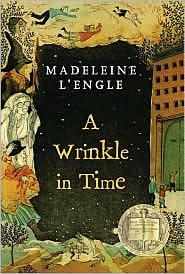
Talk to A Wrinkle in Time like its author wrote you back.
Get the ideas that fit your life — not generic summaries.
- Chat with the book
- Audiobook-style main ideas
- Adapts to your life and goals
- Helps you take action
What it argues
A Wrinkle in Time follows Meg Murry, a prickly, self-doubting teenager whose father — a physicist working on a classified government project — has been missing for years. When three mysterious women appear and reveal the concept of "tessering," a way to fold space-time and travel across the universe, Meg sets off with her gifted younger brother Charles Wallace and her new friend Calvin to find him. The journey takes them across planets and through dimensions, culminating in a confrontation with an entity of pure malevolent darkness called IT.
The book is ultimately about what love actually does, as opposed to what we say it does. L'Engle is unambiguous that love is not warm sentiment; it is an active, costly force capable of defeating evil where logic and brute strength cannot. The central conflict is between IT — a disembodied brain that enforces total conformity and calls it happiness — and Meg's chaotic, flawed, deeply personal love for her brother. What makes the novel memorable is that it refuses to equate love with niceness or safety. Meg is angry throughout; her love is fierce and inconvenient.
What it gets right
- 1.
IT represents the seductive horror of enforced sameness — a brain that eliminates suffering by eliminating selfhood, and frames this as mercy.
- 2.
Meg's faults — her rage, her stubbornness, her refusal to be appeased — turn out to be exactly what saves her brother. The qualities she's ashamed of are her weapons.
- 3.
L'Engle treats the universe as fundamentally moral. Darkness is real and powerful but not ultimate; it exists alongside and in contest with light.
What it covers
Who wrote it
Madeleine L'Engle (1918–2007) was an American novelist best known for the Time Quintet, which begins with A Wrinkle in Time. She won the Newbery Medal in 1963, though the book had been rejected by dozens of publishers before finding a home. L'Engle was a practicing Episcopalian who wrote openly about faith, and her fiction often merged science and spirituality in ways that made it difficult to categorize. Her other notable works include A Wind in the Door, A Swiftly Tilting Planet, and the Austin Family Chronicles. She lived for many years in New York City and in rural Connecticut.
