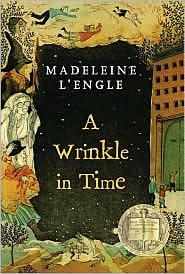
A Wrinkle in Time by Madeleine L'Engle is a 1962 fantasy book about good versus evil, love as resistance, conformity and individuality. IT represents the seductive horror of enforced sameness — a brain that eliminates suffering by eliminating selfhood, and frames this as mercy.
Summary
A Wrinkle in Time follows Meg Murry, a prickly, self-doubting teenager whose father — a physicist working on a classified government project — has been missing for years. When three mysterious women appear and reveal the concept of "tessering," a way to fold space-time and travel across the universe, Meg sets off with her gifted younger brother Charles Wallace and her new friend Calvin to find him. The journey takes them across planets and through dimensions, culminating in a confrontation with an entity of pure malevolent darkness called IT.
The book is ultimately about what love actually does, as opposed to what we say it does. L'Engle is unambiguous that love is not warm sentiment; it is an active, costly force capable of defeating evil where logic and brute strength cannot. The central conflict is between IT — a disembodied brain that enforces total conformity and calls it happiness — and Meg's chaotic, flawed, deeply personal love for her brother. What makes the novel memorable is that it refuses to equate love with niceness or safety. Meg is angry throughout; her love is fierce and inconvenient.
Published in 1962 after being rejected by roughly 26 publishers, it became an unlikely classic that mixed quantum physics, Christian mysticism, and children's adventure in ways that still feel strange and original. L'Engle was writing for children but not writing down to them — the cosmology is genuinely weird, the emotional stakes are adult, and the theology is idiosyncratic enough that the book has been challenged by both religious conservatives (for its mysticism) and secular readers (for its Christianity). That tension is part of what makes it interesting.
Readers who want a comforting, tidy fantasy will struggle here — the climax turns on something that can't be diagrammed, and the universe L'Engle builds is more frightening than charming. Readers willing to sit with that strangeness will find a book that has genuinely unusual things to say about consciousness, freedom, and the cost of caring about someone.
Talk to A Wrinkle in Time like its author wrote you back.
Get the ideas that fit your life — not generic summaries.
- Chat with the book
- Audiobook-style main ideas
- Adapts to your life and goals
- Helps you take action
Key takeaways
- 1.
IT represents the seductive horror of enforced sameness — a brain that eliminates suffering by eliminating selfhood, and frames this as mercy.
- 2.
Meg's faults — her rage, her stubbornness, her refusal to be appeased — turn out to be exactly what saves her brother. The qualities she's ashamed of are her weapons.
- 3.
L'Engle treats the universe as fundamentally moral. Darkness is real and powerful but not ultimate; it exists alongside and in contest with light.
- 4.
The tesseract is both literal and metaphorical: the shortcut through dimensions mirrors the way love and intuition bypass the ordinary logic of a problem.
- 5.
Charles Wallace's extreme intelligence becomes a liability — his certainty that he can engage with evil without being changed by it is the setup for his capture.
- 6.
The three Mrs. W figures (Mrs. Whatsit, Mrs. Who, Mrs. Which) are ancient beings who have fought darkness for eons; their whimsy conceals power and grief.
- 7.
Calvin's arc suggests that belonging and family can be chosen, not just inherited — he is more at home with the Murrys than with his own parents.
- 8.
The book argues that uniformity is a form of evil, even when it is comfortable. Camazotz's horror is not that it's cruel but that it's efficient.
Discussion questions
Use these on your own, with a book club, or as chat starters in Superbook. Book club version, ready to copy or print →
- 1.
IT offers the people of Camazotz freedom from pain, uncertainty, and failure. What exactly is wrong with that offer, and does the book answer the question satisfyingly?
- 2.
Meg's defining flaw — her anger — ends up being the key to rescuing Charles Wallace. Does the novel earn that turn, or does it feel convenient?
- 3.
Charles Wallace is extraordinarily gifted and completely confident he can outsmart IT. What does his capture suggest about the relationship between intelligence and vulnerability?
- 4.
Mrs. Whatsit, Mrs. Who, and Mrs. Which are presented as forces of good, but they give Meg incomplete information and leave her in danger repeatedly. Are they trustworthy?
- 5.
The book was rejected by 26 publishers, reportedly because it was too strange to categorize. Reading it now, what is it actually? Fantasy, science fiction, spiritual allegory?
- 6.
L'Engle openly draws on Christian imagery but also on quantum physics and non-Western traditions. Does the mixture feel coherent, or does it fall apart under scrutiny?
- 7.
Calvin chooses the Murrys over his own family. The novel treats this as natural and right. Is that a healthy message about chosen family, or does it skip over something complicated?
- 8.
The climax is explicitly that IT cannot understand love, and love defeats it. Is that a satisfying resolution to the conflict, or does it feel like a cheat?
- 9.
Meg spends most of the book hating herself. How does L'Engle use that self-hatred — is it simply overcome by the end, or does something more interesting happen to it?
- 10.
Camazotz is clearly meant to evoke both Nazi Germany and Soviet Communism. Does that historical context make it more powerful, or does it limit the metaphor?
- 11.
The Mrs. W figures have fought darkness across the universe for millennia. The fact that they can be defeated but keep going anyway — what does the book make of that?
- 12.
How does A Wrinkle in Time handle the problem of a good, all-powerful force coexisting with real evil? Does it offer any answer, or does it just accept the paradox?
Themes
Frequently asked questions
-
Is A Wrinkle in Time a children's book?
It's published as one, but the ideas — about consciousness, conformity, the nature of evil, and the mechanics of love — read as genuinely adult concerns. Many adults report it landing differently on a reread. The emotions are sophisticated; the writing is not dumbed down.
-
Is A Wrinkle in Time religious?
It draws heavily on Christian theology, but L'Engle's version is syncretic enough that it has been challenged by conservative Christian groups who found it unorthodox. The book uses explicitly Christian language while also drawing on science and other traditions. It's spiritual rather than doctrinal.
-
Why was A Wrinkle in Time rejected so many times?
Publishers couldn't categorize it. It was too strange for straightforward children's books, too childlike for adult science fiction, and too theologically idiosyncratic for religious publishers. L'Engle kept it in a drawer until a friend insisted she submit it again.
-
What is a tesseract?
In mathematics, a tesseract is a four-dimensional hypercube. L'Engle uses it as a metaphor for folding space — traveling instantaneously between points by going through a higher dimension rather than across ordinary distance. It's the book's central science fiction conceit.
-
Is the 2018 film adaptation worth watching?
The 2018 Disney film directed by Ava DuVernay received mixed reviews. It updates the visual imagery significantly and makes the diversity of the cast central to its adaptation choices, but many readers found it lost the book's stranger and darker elements. Worth watching separately from the book rather than as a substitute.