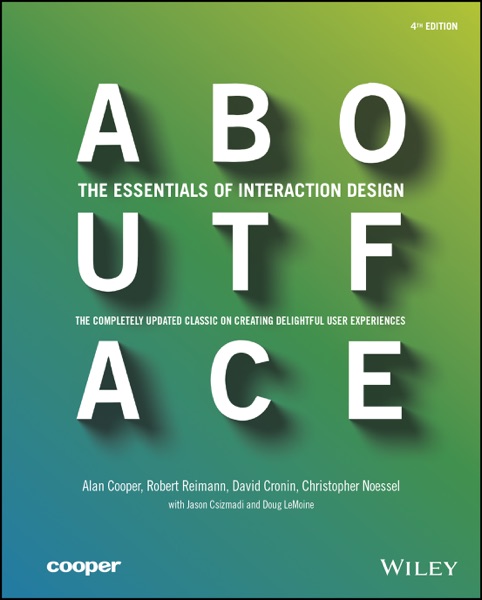
Talk to About Face: The Essentials of Interaction Design like its author wrote you back.
Get the ideas that fit your life — not generic summaries.
- Chat with the book
- Audiobook-style main ideas
- Adapts to your life and goals
- Helps you take action
About Face: The Essentials of Interaction Design, in detail
Alan Cooper's About Face, first published in 1995 and revised through multiple editions, is the foundational text of interaction design as a professional discipline. Cooper invented the concept of user personas — hypothetical archetypes representing user needs and behaviors — and this book is where he first laid out the systematic design approach built around them. The book has been substantially updated in later editions (About Face 3 in 2007, About Face 4 in 2014, co-written with Robert Reimann, David Cronin, and Christopher Noessel), but the core intellectual contribution remains Cooper's original insistence that software should be designed for how people actually think, not for how engineers build systems.
The central argument is that most software fails not because it is technically deficient but because it is designed from the wrong starting point. When engineers design software, they naturally organize it around the underlying data model, the implementation architecture, or the history of how the system was built. Users don't know or care about any of those things: they have mental models built from the tasks they're trying to accomplish and the physical and conceptual metaphors that feel natural to them. The gap between these two frames — the implementation model and the mental model — is the source of most software confusion, frustration, and error.
Cooper introduces the concept of Goal-Directed Design as the alternative. Design starts with research into user goals, not with requirements or technical constraints. Personas are the tool for holding user research in place during design: instead of abstractly referencing "the user," designers commit to specific, named, goal-defined personas whose needs and behaviors guide design decisions. Scenarios — narrative descriptions of how personas use a system to accomplish their goals — are the tool for testing whether a design actually serves those needs.
The book also covers a large range of interaction patterns and behaviors: navigation, controls, data display, error handling, form design, and more. These sections are practical and specific, and while some examples are dated (Windows 95 and early web interfaces), the underlying principles remain valid. About Face is a long book, and it rewards selective reading after the foundational chapters. It is the text that established interaction design as a discipline separate from graphic design and from software engineering, and it remains the best argument for that separation.
The big ideas
- 1.
Most software fails because it is designed from the implementation model — the way engineers build systems — rather than the mental model of users who think in terms of goals and tasks.
- 2.
Personas are hypothetical user archetypes defined by goals and behaviors, not demographics. They give design teams a specific, consistent target rather than an abstract 'user' that everyone interprets differently.
- 3.
Goal-Directed Design starts with user research, not requirements: the question is not 'what does the system need to do?' but 'what are users trying to accomplish, and how do they think about it?'
