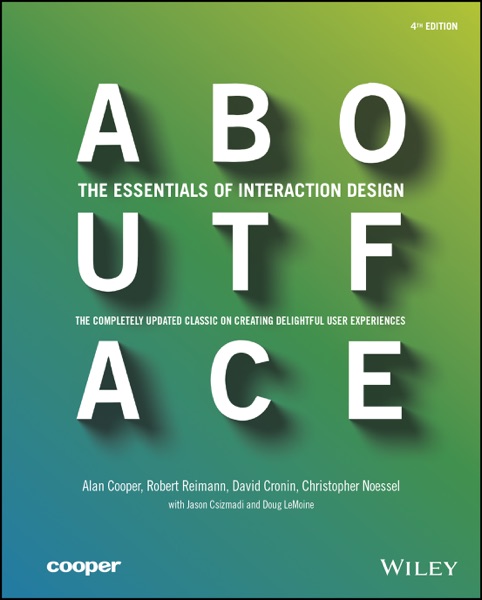
About Face: The Essentials of Interaction Design by Alan Cooper is a 1995 science book about interaction design, user-centered design, mental models. Most software fails because it is designed from the implementation model — the way engineers build systems — rather than the mental model of users who think in terms of goals and tasks.
Summary
Alan Cooper's About Face, first published in 1995 and revised through multiple editions, is the foundational text of interaction design as a professional discipline. Cooper invented the concept of user personas — hypothetical archetypes representing user needs and behaviors — and this book is where he first laid out the systematic design approach built around them. The book has been substantially updated in later editions (About Face 3 in 2007, About Face 4 in 2014, co-written with Robert Reimann, David Cronin, and Christopher Noessel), but the core intellectual contribution remains Cooper's original insistence that software should be designed for how people actually think, not for how engineers build systems.
The central argument is that most software fails not because it is technically deficient but because it is designed from the wrong starting point. When engineers design software, they naturally organize it around the underlying data model, the implementation architecture, or the history of how the system was built. Users don't know or care about any of those things: they have mental models built from the tasks they're trying to accomplish and the physical and conceptual metaphors that feel natural to them. The gap between these two frames — the implementation model and the mental model — is the source of most software confusion, frustration, and error.
Cooper introduces the concept of Goal-Directed Design as the alternative. Design starts with research into user goals, not with requirements or technical constraints. Personas are the tool for holding user research in place during design: instead of abstractly referencing "the user," designers commit to specific, named, goal-defined personas whose needs and behaviors guide design decisions. Scenarios — narrative descriptions of how personas use a system to accomplish their goals — are the tool for testing whether a design actually serves those needs.
The book also covers a large range of interaction patterns and behaviors: navigation, controls, data display, error handling, form design, and more. These sections are practical and specific, and while some examples are dated (Windows 95 and early web interfaces), the underlying principles remain valid. About Face is a long book, and it rewards selective reading after the foundational chapters. It is the text that established interaction design as a discipline separate from graphic design and from software engineering, and it remains the best argument for that separation.
Talk to About Face: The Essentials of Interaction Design like its author wrote you back.
Get the ideas that fit your life — not generic summaries.
- Chat with the book
- Audiobook-style main ideas
- Adapts to your life and goals
- Helps you take action
Key takeaways
- 1.
Most software fails because it is designed from the implementation model — the way engineers build systems — rather than the mental model of users who think in terms of goals and tasks.
- 2.
Personas are hypothetical user archetypes defined by goals and behaviors, not demographics. They give design teams a specific, consistent target rather than an abstract 'user' that everyone interprets differently.
- 3.
Goal-Directed Design starts with user research, not requirements: the question is not 'what does the system need to do?' but 'what are users trying to accomplish, and how do they think about it?'
- 4.
Scenarios — narrative accounts of a persona accomplishing a goal — are the primary design tool. If you can't tell a clear story of a persona succeeding, the design is not good enough.
- 5.
Software should behave like a knowledgeable friend, not a bureaucratic system: it should anticipate what users want, provide appropriate defaults, and not ask users to specify things the system already knows.
- 6.
Cooper's concept of 'perpetual intermediates' — users who are neither complete beginners nor power users, and who stay at that level indefinitely — argues against designing for the extremes.
- 7.
Error messages are almost always a design failure, not a user failure: if a user makes an error that the system could have prevented or anticipated, the system is poorly designed.
- 8.
The boundary between a good and bad interface is not aesthetic — it is whether the interface matches the user's mental model of the task. Good design disappears; bad design creates friction.
Discussion questions
Use these on your own, with a book club, or as chat starters in Superbook. Book club version, ready to copy or print →
- 1.
Cooper argues that most software is designed from the engineer's implementation model rather than the user's mental model. Can you think of a piece of software that clearly falls into each category?
- 2.
Personas have become a standard UX tool, but they've also been criticized as reductive or fictional. What are the strongest arguments for and against using them in design practice?
- 3.
He distinguishes between user goals (what someone is trying to accomplish in life) and tasks (the steps the system requires). How often does software mistake tasks for goals? What does that mistake produce?
- 4.
The concept of 'perpetual intermediates' — users who never become experts and never stay beginners — argues against designing for the extremes. Does your experience as a user support that observation?
- 5.
Cooper is critical of feature accumulation — the tendency for software to add capabilities in response to user requests rather than user needs. Is that criticism fair? Who should decide what a product includes?
- 6.
About Face was first published in 1995. How much of the core argument needs updating for contemporary design challenges: mobile-first, voice interfaces, AI-generated UI? What remains stable?
- 7.
Error prevention versus error recovery: Cooper argues that a well-designed system should prevent errors rather than handle them. Is that always possible? When should recovery rather than prevention be the priority?
- 8.
He argues that software should behave like a 'knowledgeable friend' — anticipating needs, providing appropriate defaults, not requiring users to understand the underlying system. What are the privacy and autonomy implications of that ideal?
- 9.
The book is long and comprehensive. What does that format suggest about the intended audience and how they were expected to use the book?
- 10.
Interaction design as Cooper defined it is now a large professional field. Has the field fulfilled his vision? Where has it succeeded and where has it drifted from the original goals?
- 11.
Cooper was also the creator of Visual Basic, which made programming accessible to non-engineers. How does his background as a practitioner shape the arguments he makes in About Face?
Themes
Frequently asked questions
-
Is About Face still worth reading given how old it is?
The fourth edition (2014) is updated for contemporary platforms, but even the core ideas from the original edition remain foundational. Cooper's argument about mental models, implementation models, and goal-directed design is as valid for mobile and AI interfaces as it was for desktop software.
-
What is the most important idea in About Face?
The distinction between the implementation model (how engineers build a system) and the mental model (how users think about their tasks). Designing to match the mental model is the fundamental insight the book is built on.
-
How long does About Face take to read?
The fourth edition is over 700 pages and takes most readers twelve to fifteen hours to read cover to cover. Most practitioners read the foundational chapters carefully and use the later sections as a reference. It is a reference book as much as a read-through.
-
What are user personas and why did Cooper invent them?
Personas are specific, named, fictional users with defined goals, behaviors, and contexts, created from user research. Cooper invented them because design teams kept designing for a vague, generic 'user' that everyone on the team imagined differently. A persona forces agreement on who you're actually designing for.
-
Who should read About Face?
UX designers, product managers, software developers who work with user-facing products, and anyone who commissions or evaluates interaction design. The foundational chapters are accessible to non-designers; the later sections are reference material for practitioners.