Talk to AI Superpowers like its author wrote you back.
Get the ideas that fit your life — not generic summaries.
- Chat with the book
- Audiobook-style main ideas
- Adapts to your life and goals
- Helps you take action
What it argues
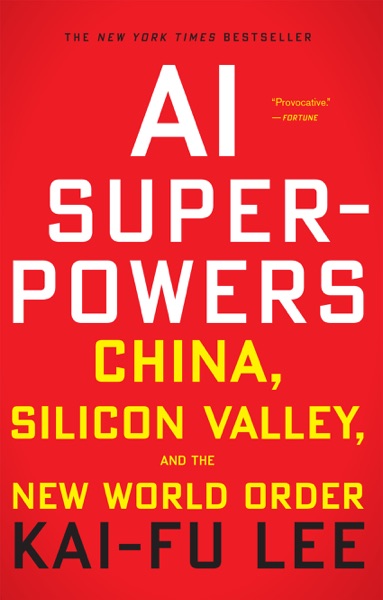
AI Superpowers is Kai-Fu Lee's argument that the geopolitical competition to lead in artificial intelligence is primarily a two-country race between the United States and China, and that the outcome will reshape the global economy in ways most people haven't started to reckon with. Lee is unusually positioned to make this case: he ran Google China, founded a major Beijing venture capital firm, and trained under AI pioneer Geoffrey Hinton. The book draws on that dual vantage point rather than on secondhand analysis.
Lee's core claim is that the era of AI discovery—inventing new algorithms—is largely over. What matters now is implementation: applying existing AI to real problems at scale. On that dimension, China has structural advantages that the US AI community consistently underestimates. China has more data, a culture of execution and imitation that moves faster than American startups typically allow, and a government willing to treat AI as national strategy. Lee doesn't argue China will win outright, but he does argue that the default Silicon Valley assumption—that the US leads by default—is wrong.
What it gets right
- 1.
The AI era is no longer about breakthroughs. The breakthrough—deep learning—has already happened. The race now is about implementation, data, and scale.
- 2.
China has structural advantages in AI deployment: massive data from its 1.4 billion users, a government that funds and clears obstacles, and a startup culture that prizes rapid iteration over elegance.
- 3.
Lee estimates AI will displace roughly 40 percent of jobs within 15 years. Routine cognitive tasks—loan officer, customer service, basic diagnostics—are most exposed.
What it covers
Who wrote it
Kai-Fu Lee is a Taiwanese-American computer scientist and venture capitalist. He earned his PhD in computer science from Carnegie Mellon, worked at Apple, SGI, and Microsoft before joining Google, where he served as president of Google China from 2006 to 2009. He then founded Sinovation Ventures, a Beijing-based VC firm focused on Chinese technology startups. Lee is widely regarded as one of the most knowledgeable figures on both the American and Chinese AI ecosystems. AI Superpowers, published in 2018, drew on his unusual dual perspective and became a bestseller in both countries.
