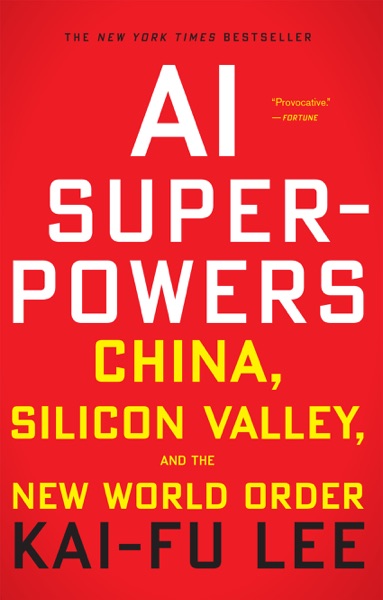
AI Superpowers by Kai-Fu Lee is a 2018 business book about artificial intelligence, us-china competition, technology policy. The AI era is no longer about breakthroughs. The breakthrough—deep learning—has already happened. The race now is about implementation, data, and scale.
Summary
AI Superpowers is Kai-Fu Lee's argument that the geopolitical competition to lead in artificial intelligence is primarily a two-country race between the United States and China, and that the outcome will reshape the global economy in ways most people haven't started to reckon with. Lee is unusually positioned to make this case: he ran Google China, founded a major Beijing venture capital firm, and trained under AI pioneer Geoffrey Hinton. The book draws on that dual vantage point rather than on secondhand analysis.
Lee's core claim is that the era of AI discovery—inventing new algorithms—is largely over. What matters now is implementation: applying existing AI to real problems at scale. On that dimension, China has structural advantages that the US AI community consistently underestimates. China has more data, a culture of execution and imitation that moves faster than American startups typically allow, and a government willing to treat AI as national strategy. Lee doesn't argue China will win outright, but he does argue that the default Silicon Valley assumption—that the US leads by default—is wrong.
The second half of the book shifts from geopolitics to labor economics. Lee estimates that AI will displace roughly 40 percent of global jobs within 15 years, with repetitive cognitive tasks most at risk: loan officers, radiologists reading standard images, customer service agents. The jobs least at risk are those requiring creativity, genuine human connection, or physical dexterity in unpredictable settings. He argues existing safety nets are nowhere near adequate for the transition.
The book ends on a personal note unusual for a technology executive. Lee was diagnosed with lymphoma while writing and describes the experience changing his framework. He argues that human compassion and care—the things AI demonstrably cannot replicate—should be the foundation of whatever we build next. The tone shifts from competitive analysis to something closer to an appeal. Readers looking for a clear-eyed account of AI's economic consequences will find it here, though the optimism in the final chapters reads somewhat against the weight of the preceding evidence.
Talk to AI Superpowers like its author wrote you back.
Get the ideas that fit your life — not generic summaries.
- Chat with the book
- Audiobook-style main ideas
- Adapts to your life and goals
- Helps you take action
Key takeaways
- 1.
The AI era is no longer about breakthroughs. The breakthrough—deep learning—has already happened. The race now is about implementation, data, and scale.
- 2.
China has structural advantages in AI deployment: massive data from its 1.4 billion users, a government that funds and clears obstacles, and a startup culture that prizes rapid iteration over elegance.
- 3.
Lee estimates AI will displace roughly 40 percent of jobs within 15 years. Routine cognitive tasks—loan officer, customer service, basic diagnostics—are most exposed.
- 4.
Jobs safe from AI tend to involve creative strategy, genuine human empathy, or physical dexterity in novel settings. No algorithm yet understands context the way a skilled nurse or plumber does.
- 5.
Silicon Valley's belief that US leadership in AI research translates automatically into AI leadership in deployment is a complacency Lee treats as dangerous.
- 6.
China's government AI strategy isn't just rhetoric. Funding, regulatory fast-lanes, and mandated data sharing create an implementation environment with no US equivalent.
- 7.
Lee's lymphoma diagnosis reoriented his thinking: the things AI cannot do—love, care, moral reasoning—are the things most worth protecting and building around.
- 8.
The policy response to AI displacement will define the next era of politics. Universal basic income is one approach; Lee prefers expanding social investment programs that reward caregiving.
Discussion questions
Use these on your own, with a book club, or as chat starters in Superbook. Book club version, ready to copy or print →
- 1.
Lee argues the AI implementation race has replaced the AI research race. Does that framing change how you think about which countries, companies, or people are positioned well?
- 2.
China's data advantage comes partly from weaker privacy norms. Is that a feature of their AI strategy or a liability waiting to materialize?
- 3.
Lee estimates 40 percent job displacement. How does that compare to past technological transitions, and why might this one be different or the same?
- 4.
Which jobs in your own field do you think are most and least exposed to AI displacement? What's the actual difference between the two categories?
- 5.
Lee distinguishes between AI that processes data and humans who provide compassion. Is that a stable distinction, or will AI erode the compassion side over time?
- 6.
What would an adequate policy response to AI-driven displacement actually require? What's the realistic political path to getting there?
- 7.
Lee is explicitly bullish on China's AI trajectory. What would have to be true for his case to be wrong?
- 8.
The book's final chapters argue for revaluing human care. Is that a political argument, a personal one, or both? Do you find it convincing?
- 9.
Silicon Valley culture prizes moonshots over incremental implementation. Is that an AI strength or a weakness compared to the Chinese approach Lee describes?
- 10.
Lee wrote the book partly while being treated for cancer. Does the personal arc change how you read the policy prescriptions?
- 11.
What does AI leadership actually mean for ordinary citizens in the US or China? Is the competition framing useful or misleading at that level?
- 12.
If AI displaces 40 percent of jobs, what happens to the social contract around work, identity, and dignity? Which of those is hardest to replace?
Themes
Frequently asked questions
-
Is AI Superpowers worth reading in 2026?
Yes, with the caveat that some specific predictions have already been tested. The structural analysis of US-China AI competition, the job displacement framework, and the data-advantage argument all remain relevant. The book is better as a framework than as a forecast.
-
What is the main argument of AI Superpowers?
That the AI era has shifted from research to implementation, China has significant structural advantages in implementation, and the coming job displacement will require policy responses that neither country is currently building fast enough.
-
Who should read AI Superpowers?
Policymakers, technology executives, and anyone trying to understand the economic and geopolitical stakes of AI beyond the usual Silicon Valley framing. It's more accessible than most AI books and less prone to either hype or doom.
-
How does AI Superpowers handle the job displacement question?
Lee estimates 40 percent displacement over 15 years and categorizes jobs by exposure. He's more willing than most tech authors to name specific occupations at risk and to take the policy problem seriously rather than assuming the market will sort it out.
-
What is Lee's background and why does it matter for this book?
Lee ran Google China and then founded a major Chinese VC firm, giving him direct experience with both ecosystems. That dual vantage point is what makes the book's China analysis credible — it's not secondhand observation.
Similar books

The Alignment Problem
Brian Christian
Superintelligence: Paths, Dangers, Strategies
Nick Bostrom

Homo Deus: A Brief History of Tomorrow
Yuval Noah Harari
The Second Machine Age
Erik Brynjolfsson and Andrew McAfee
