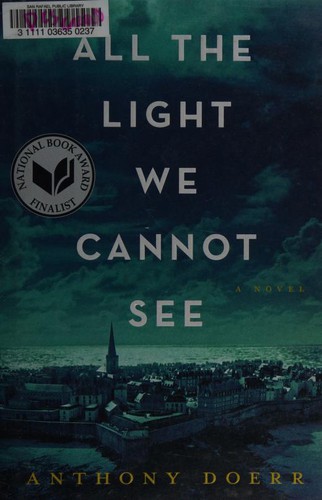
Talk to All the Light We Cannot See like its author wrote you back.
Get the ideas that fit your life — not generic summaries.
- Chat with the book
- Audiobook-style main ideas
- Adapts to your life and goals
- Helps you take action
All the Light We Cannot See, in detail
All the Light We Cannot See follows two children through the Second World War on a collision course neither can see coming. Marie-Laure LeBlanc is a blind French girl whose father, a locksmith at the Paris Natural History Museum, flees occupied Paris carrying what may be a cursed diamond. Werner Pfennig is an orphan from a German mining town whose genius with radio technology earns him a place in the Hitler Youth — and eventually in the Wehrmacht. The novel moves back and forth in time, building toward the night Allied bombers level the walled city of Saint-Malo, where both children's stories will finally intersect.
At its core, the book is about the question of moral survival under totalitarianism: what it costs to comply, what it requires to resist, and how much agency anyone really has in the machinery of history. Marie-Laure's arc is essentially one of endurance — she is protected, guided, and finally left to protect herself. Werner's arc is darker and more interesting: a boy who knows what is being done in his name and who chooses, piece by piece, to look away. Doerr is unsparing about the cost of that looking away, and the novel earns its emotional weight through Werner's complicity more than through any single act of violence.
The prose is gorgeous and the structure is demanding. Short chapters — many less than a page — alternate between timelines and characters, building a mosaic that asks you to hold many threads simultaneously. Doerr won the Pulitzer Prize for Fiction in 2015, and the award reflects the book's ambition: it is trying to be both a propulsive story and a meditation on beauty, light, and the uses of science. The radio is the novel's central symbol — it connects, it broadcasts propaganda, it saves lives and ends them — and Doerr uses it with real precision.
Readers who love immersive historical fiction with lyrical prose will be absorbed. Readers who want tighter plotting and less ornamentation may feel the novel's length (530 pages) is not quite justified by its revelations. The 2023 Netflix adaptation stripped the story to its bones; the novel's value is precisely in the bones it leaves in.
The big ideas
- 1.
Doerr's central argument is that beauty and atrocity coexist in the same moment — the same radio frequency that broadcasts Nazi propaganda also carries music and human connection.
- 2.
Werner's arc is a study in incremental moral erosion: each small compromise makes the next one easier, until the person he's become is unrecognizable to his younger self.
- 3.
The diamond curse is handled with deliberate ambiguity — the novel never commits to whether the supernatural is real, using it instead to ask whether believing in fate absolves people of choice.
