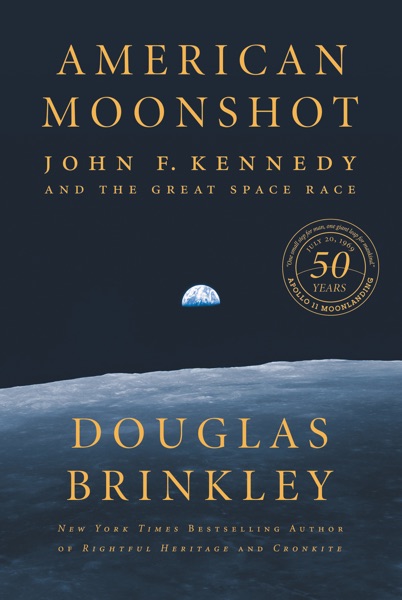
Talk to American Moonshot like its author wrote you back.
Get the ideas that fit your life — not generic summaries.
- Chat with the book
- Audiobook-style main ideas
- Adapts to your life and goals
- Helps you take action
What it argues
Douglas Brinkley's American Moonshot focuses less on the engineering triumph of Apollo 11 than on the political decision that made it possible: John F. Kennedy's May 1961 commitment to land a man on the Moon before the end of the decade. Brinkley, a presidential historian who has written extensively on American political life, treats Kennedy's moonshot as one of the great acts of national leadership in American history — a commitment made under enormous uncertainty, with genuinely no clear path to execution at the time it was announced.
The book's first half traces the Cold War context that made the decision urgent. Sputnik's 1957 launch had created a sense of national emergency, amplified by the failed Bay of Pigs invasion which had humiliated Kennedy in his first months in office. When cosmonaut Yuri Gagarin became the first human in space in April 1961, the gap between American and Soviet capability seemed catastrophic. Kennedy, Brinkley argues, chose the Moon precisely because it was beyond both nations' current reach — it was a race that could be won on equal terms with sufficient commitment and resources.
What it gets right
- 1.
Kennedy chose the Moon partly because it was beyond both superpowers' current reach — a race that could be run from roughly equal starting positions with sufficient commitment.
- 2.
The political decision to go to the Moon preceded any clear engineering path to do it. Kennedy committed to the outcome and trusted that the path would be found.
- 3.
James Webb's management of NASA — growing it from a few thousand employees to hundreds of thousands while maintaining technical rigor — is as significant an achievement as the rocket engineering.
What it covers
Who wrote it
Douglas Brinkley is a presidential historian and professor at Rice University who has written more than twenty books on American history and political life, including biographies of Jimmy Carter, Gerald Ford, Rosa Parks, and Walter Cronkite, and histories of American environmentalism and the Great Society. He is a CNN presidential historian and a regular contributor to major publications. American Moonshot was published in 2019, the fiftieth anniversary of the Apollo 11 landing, and drew on extensive archival research including previously classified NASA and White House documents.
