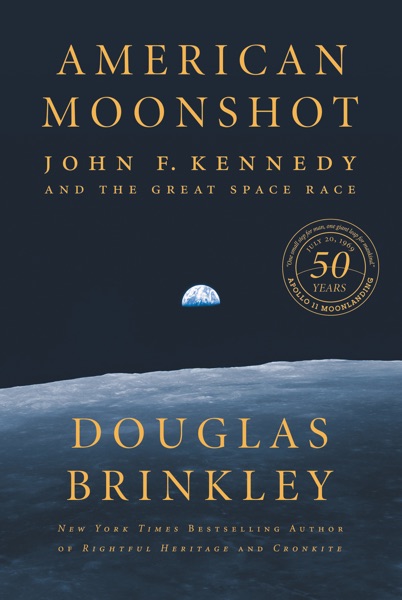
American Moonshot by Douglas Brinkley is a 2019 history book about space exploration, leadership, cold war. Kennedy chose the Moon partly because it was beyond both superpowers' current reach — a race that could be run from roughly equal starting positions with sufficient commitment.
Summary
Douglas Brinkley's American Moonshot focuses less on the engineering triumph of Apollo 11 than on the political decision that made it possible: John F. Kennedy's May 1961 commitment to land a man on the Moon before the end of the decade. Brinkley, a presidential historian who has written extensively on American political life, treats Kennedy's moonshot as one of the great acts of national leadership in American history — a commitment made under enormous uncertainty, with genuinely no clear path to execution at the time it was announced.
The book's first half traces the Cold War context that made the decision urgent. Sputnik's 1957 launch had created a sense of national emergency, amplified by the failed Bay of Pigs invasion which had humiliated Kennedy in his first months in office. When cosmonaut Yuri Gagarin became the first human in space in April 1961, the gap between American and Soviet capability seemed catastrophic. Kennedy, Brinkley argues, chose the Moon precisely because it was beyond both nations' current reach — it was a race that could be won on equal terms with sufficient commitment and resources.
The middle sections deal with Kennedy's management of the space program: his relationships with NASA administrator James Webb, rocket pioneer Wernher von Braun, and the astronauts themselves. Brinkley is particularly good on the political mechanics — the budget negotiations, the congressional resistance, the public communications challenges — that turned a presidential speech into a functioning national program. Webb's management of NASA, which grew from a small agency to an organization employing hundreds of thousands of people, is treated as an organizational achievement comparable in scale to the engineering one.
The final third covers Kennedy's death and the question of whether Apollo would have survived without him. Brinkley argues that Lyndon Johnson, whose career was deeply tied to the space program from its earliest days, provided essential continuity. The book ends with Apollo 11's landing as a fulfillment of Kennedy's promise, but also as a bittersweet triumph — a national achievement that its initiator did not live to see.
Talk to American Moonshot like its author wrote you back.
Get the ideas that fit your life — not generic summaries.
- Chat with the book
- Audiobook-style main ideas
- Adapts to your life and goals
- Helps you take action
Key takeaways
- 1.
Kennedy chose the Moon partly because it was beyond both superpowers' current reach — a race that could be run from roughly equal starting positions with sufficient commitment.
- 2.
The political decision to go to the Moon preceded any clear engineering path to do it. Kennedy committed to the outcome and trusted that the path would be found.
- 3.
James Webb's management of NASA — growing it from a few thousand employees to hundreds of thousands while maintaining technical rigor — is as significant an achievement as the rocket engineering.
- 4.
Cold War competition created the conditions for the investment. Without the Soviet space program providing an existential threat, it is doubtful Congress would have funded Apollo at the necessary scale.
- 5.
Wernher von Braun's presence in the American space program required deliberate forgetting of his wartime past. The ethical compromises involved in that are not absent from the story.
- 6.
Kennedy's public framing of the moonshot — 'We choose to go to the Moon not because it is easy but because it is hard' — was a masterclass in political communication that converted a resource commitment into a national identity.
- 7.
Lyndon Johnson's sustained support for the space program, spanning his time as Senate majority leader through his presidency, was essential to Apollo's survival through Kennedy's assassination.
- 8.
Apollo's success created a template for ambitious national projects that still shapes how Americans think about what government can accomplish, and a standard that subsequent projects have rarely matched.
Discussion questions
Use these on your own, with a book club, or as chat starters in Superbook. Book club version, ready to copy or print →
- 1.
Kennedy committed to the Moon before there was a clear plan for how to get there. When, in leadership, is it appropriate to commit to an outcome before you know the path, and when is that reckless?
- 2.
Brinkley argues the Cold War made the Moon mission possible. Would a comparable national investment in science and engineering be politically achievable without a comparable external threat?
- 3.
Wernher von Braun built rockets for the Nazis before building them for NASA. How do you evaluate the decision to use his expertise, and does historical distance make that evaluation easier or harder?
- 4.
Kennedy's 'We choose to go to the Moon' speech is one of the most celebrated examples of political communication. What made it work, and what communication challenge in your own context could learn from it?
- 5.
NASA grew from a small agency to a massive organization within a decade. What was gained and what was probably lost in that growth?
- 6.
Kennedy didn't live to see the Moon landing. How does it change your relationship to a project or commitment when you know the initiator won't see it completed?
- 7.
Brinkley is sympathetic to Kennedy throughout. What might a less sympathetic reading of the same decision — its costs, its diversion of resources, its Cold War motives — look like?
- 8.
Apollo set a standard for what focused national investment can achieve. What contemporary problem deserves equivalent scale of attention and resources?
- 9.
The Moon program employed hundreds of thousands of people across the country. How does that kind of distributed national effort differ from equivalent private-sector investment?
- 10.
The space race was explicitly competitive with the Soviet Union. Are there domains today where international competition is similarly driving technological progress?
- 11.
Fifty years after Apollo 11, human spaceflight has become dominated by private companies rather than government agencies. Does that shift represent progress, regression, or simply change?
- 12.
Which decision — committing to the Moon in 1961, or achieving it in 1969 — required more courage?
Themes
Frequently asked questions
-
Is American Moonshot about the Apollo 11 mission itself or about Kennedy?
Primarily about Kennedy's decision and the political history of the space program. The Apollo 11 landing appears near the end as the culmination of a political story, not as the center of an engineering narrative. Readers who want detailed coverage of the mission itself should supplement with other books.
-
How does this compare to other Apollo books?
Most Apollo books focus on the astronauts and engineers — The Right Stuff, Carrying the Fire, Rocket Men. Brinkley's focus is political and presidential, making American Moonshot a complementary rather than a competing volume. It covers territory the other books leave mostly to background.
-
Does the book address the ethical issues around von Braun?
Yes, with more directness than many space history books. Brinkley acknowledges the deliberate overlooking of von Braun's wartime record and does not fully excuse it, though he ultimately treats it as a pragmatic decision made in a particular historical context.
-
Who should read American Moonshot?
Readers interested in presidential decision-making, Cold War history, or the relationship between political will and technological achievement. Also useful for anyone thinking about what large-scale national coordination requires — the management of NASA is as instructive as the rocket science.
-
Is this a balanced account of Kennedy?
More admiring than critical. Brinkley acknowledges Kennedy's political calculation and the Cold War context, but the overall portrait is sympathetic. Readers who want a more skeptical account of Kennedy's motivations should supplement with other sources.
Similar books
The Right Stuff
Tom Wolfe

American Prometheus
Kai Bird and Martin J. Sherwin
Team of Rivals: The Political Genius of Abraham Lincoln
Doris Kearns Goodwin

The Innovators: How a Group of Hackers, Geniuses, and Geeks Created the Digital Revolution
Walter Isaacson
