Talk to American Nations like its author wrote you back.
Get the ideas that fit your life — not generic summaries.
- Chat with the book
- Audiobook-style main ideas
- Adapts to your life and goals
- Helps you take action
American Nations, in detail
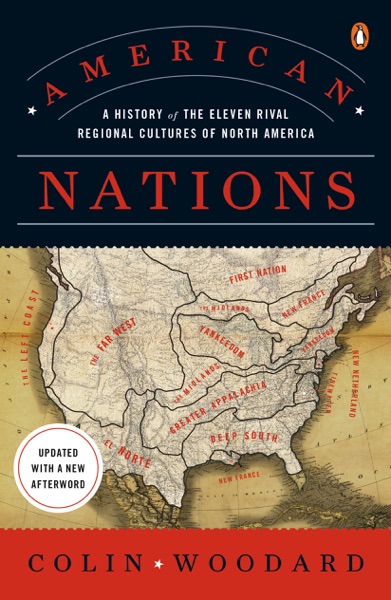
American Nations is Colin Woodard's argument that North America is not a single nation but a continent of 11 distinct regional cultures, each founded by different waves of settlers with different values, institutions, and political philosophies, and that understanding those foundational cultures is more useful for explaining American political conflict than the standard red-state/blue-state framing. Woodard is a Maine-based journalist and historian, and the book draws on four centuries of colonial, demographic, and political history.
Woodard's eleven nations—Yankeedom, the Midlands, New Netherland, Tidewater, Greater Appalachia, the Deep South, El Norte, the Left Coast, the Far West, New France, and First Nation—are defined not by current state lines but by settlement origins. Yankees brought a Puritan ethic of community improvement and consensus; Scots-Irish settlers from the borderlands of Britain created a culture of fierce individualism and distrust of centralized authority across Greater Appalachia; Dutch and English merchant settlers created a pluralistic commercial culture in what became New York. Each of these foundational cultures, Woodard argues, has been remarkably persistent across 400 years.
The book makes its case through detailed historical narrative covering each region's founding, development, and eventual interaction with the others. The recurring theme is conflict between what Woodard calls the Deep South alliance—the Deep South, Greater Appalachia, and the Far West—and the northern alliance of Yankeedom, New Netherland, and the Left Coast, with the Midlands as perpetual swing region. This framing explains patterns in American politics from the colonial era through Reconstruction, the New Deal, and the present day in ways the standard partisan analysis does not.
American Nations is most valuable as a corrective to the assumption that American political divisions are recent or superficial. The fault lines Woodard traces were present at the founding and have been contested ever since. The book's weakness is its tendency to treat regional culture as more determinative than it is—individual mobility, economic change, and deliberate cultural change don't fit cleanly into the model. But as a framework for understanding why the US has always been harder to govern than its constitution implies, it's one of the more useful books in recent American history writing.
The big ideas
- 1.
The US is not one nation but eleven regional cultures, each with distinct founding values that have persisted more than 400 years despite migration, urbanization, and mass media.
- 2.
State lines are not cultural lines. Understanding Appalachian Pennsylvania as closer in culture to Appalachian Kentucky than to Philadelphia is more illuminating than comparing states.
- 3.
The Deep South's foundational culture was explicitly modeled on Caribbean slave societies: hierarchical, hostile to democracy, and built around the interests of a landed oligarchy. That inheritance has not been fully shed.
