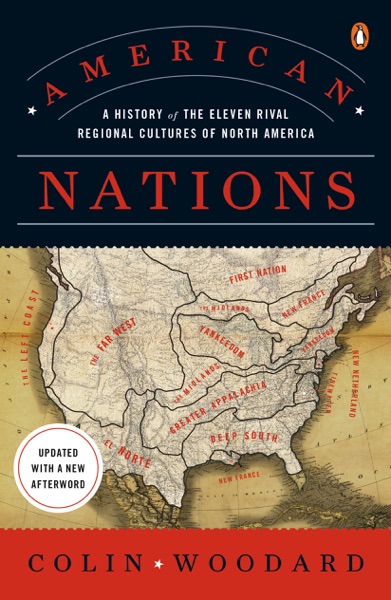
American Nations by Colin Woodard is a 2011 history book about american history, regional culture, politics. The US is not one nation but eleven regional cultures, each with distinct founding values that have persisted more than 400 years despite migration, urbanization, and mass media.
Summary
American Nations is Colin Woodard's argument that North America is not a single nation but a continent of 11 distinct regional cultures, each founded by different waves of settlers with different values, institutions, and political philosophies, and that understanding those foundational cultures is more useful for explaining American political conflict than the standard red-state/blue-state framing. Woodard is a Maine-based journalist and historian, and the book draws on four centuries of colonial, demographic, and political history.
Woodard's eleven nations—Yankeedom, the Midlands, New Netherland, Tidewater, Greater Appalachia, the Deep South, El Norte, the Left Coast, the Far West, New France, and First Nation—are defined not by current state lines but by settlement origins. Yankees brought a Puritan ethic of community improvement and consensus; Scots-Irish settlers from the borderlands of Britain created a culture of fierce individualism and distrust of centralized authority across Greater Appalachia; Dutch and English merchant settlers created a pluralistic commercial culture in what became New York. Each of these foundational cultures, Woodard argues, has been remarkably persistent across 400 years.
The book makes its case through detailed historical narrative covering each region's founding, development, and eventual interaction with the others. The recurring theme is conflict between what Woodard calls the Deep South alliance—the Deep South, Greater Appalachia, and the Far West—and the northern alliance of Yankeedom, New Netherland, and the Left Coast, with the Midlands as perpetual swing region. This framing explains patterns in American politics from the colonial era through Reconstruction, the New Deal, and the present day in ways the standard partisan analysis does not.
American Nations is most valuable as a corrective to the assumption that American political divisions are recent or superficial. The fault lines Woodard traces were present at the founding and have been contested ever since. The book's weakness is its tendency to treat regional culture as more determinative than it is—individual mobility, economic change, and deliberate cultural change don't fit cleanly into the model. But as a framework for understanding why the US has always been harder to govern than its constitution implies, it's one of the more useful books in recent American history writing.
Talk to American Nations like its author wrote you back.
Get the ideas that fit your life — not generic summaries.
- Chat with the book
- Audiobook-style main ideas
- Adapts to your life and goals
- Helps you take action
Key takeaways
- 1.
The US is not one nation but eleven regional cultures, each with distinct founding values that have persisted more than 400 years despite migration, urbanization, and mass media.
- 2.
State lines are not cultural lines. Understanding Appalachian Pennsylvania as closer in culture to Appalachian Kentucky than to Philadelphia is more illuminating than comparing states.
- 3.
The Deep South's foundational culture was explicitly modeled on Caribbean slave societies: hierarchical, hostile to democracy, and built around the interests of a landed oligarchy. That inheritance has not been fully shed.
- 4.
Yankeedom has always believed in community improvement through government action, education, and collective investment. That's not liberalism in the modern sense; it's a Puritan inheritance about what society owes itself.
- 5.
Greater Appalachia's founding Scots-Irish settlers brought a culture of fierce individualism, distrust of hierarchy, and a specific honor culture that explains political patterns from Andrew Jackson to modern libertarianism.
- 6.
The Midlands—Pennsylvania, Ohio, Indiana, much of the Midwest—are the true swing region of American politics precisely because they were founded on pluralism and tolerance rather than a strong ideological commitment.
- 7.
American political conflicts since the founding can largely be read as contests for control of federal policy between the Deep South alliance and the northern alliance, with the Midlands deciding the outcome.
- 8.
El Norte—the borderlands of the Southwest—is an American nation older than any English settlement, with its own cultural logic that doesn't map onto either the Anglo-Protestant or Deep South frameworks.
Discussion questions
Use these on your own, with a book club, or as chat starters in Superbook. Book club version, ready to copy or print →
- 1.
Woodard argues that the founding culture of a region persists for centuries despite enormous demographic change. Do you find that plausible? What mechanisms would allow a culture to persist through migration and generational turnover?
- 2.
How does the eleven-nations framing change how you think about a political issue you care about? Does it make the conflict more or less tractable?
- 3.
The book's strongest critics say it's too deterministic—that culture explains everything and individual agency explains nothing. Is that a fair criticism?
- 4.
Woodard is from Maine and lives in the Yankeedom nation. Does his perspective on the Deep South or Greater Appalachia read as sympathetic or condescending, and does it matter?
- 5.
The Midlands are described as the swing region because of their founding pluralism. Does that characterization match the Midwestern states or regions you know best?
- 6.
What does the El Norte chapter add to debates about immigration and the Southwest that a standard political analysis misses?
- 7.
Woodard argues the Left Coast is a distinctive American nation colonized partly by New Englanders traveling by sea. Does that history explain anything about California and Oregon politics today?
- 8.
The book was written in 2011. What has happened since then that either confirms or challenges the eleven-nations framework?
- 9.
Which of Woodard's eleven nations do you live in? Does the description match your experience of local culture and politics?
- 10.
The standard political analysis divides America into red and blue states. What does Woodard's framework show that the red/blue map obscures?
- 11.
Woodard argues that the Deep South alliance and the northern alliance have been in persistent conflict since the founding. Is there any historical basis for optimism that the conflict can be resolved?
- 12.
If the eleven-nations thesis is correct, what are the implications for federal policy? Does national policy become harder or easier to design?
Themes
Frequently asked questions
-
What are the eleven nations in American Nations?
Yankeedom, the Midlands, New Netherland (greater New York City), Tidewater (coastal Virginia/Maryland), Greater Appalachia, the Deep South, El Norte, the Left Coast, the Far West, New France (Quebec and southern Louisiana), and First Nation (the far north).
-
Is American Nations too reductive?
Somewhat. The framework has genuine explanatory power for political patterns and ignores individual variation, urban/rural dynamics, and deliberate cultural change. It's best used as one lens among several, not as the complete explanation.
-
How is American Nations different from other books about US political polarization?
Most polarization books are about the recent past. Woodard argues the divisions are 400 years old and rooted in founding cultural differences. That makes the conflict seem less like a deviation from a golden era of consensus and more like a deep structural feature.
-
Is American Nations written from a particular political perspective?
Woodard's sympathies lean toward the Yankeedom/northern alliance model of government. He doesn't hide that. Readers should bring appropriate skepticism to his characterizations of Deep South and Appalachian culture, which are less sympathetic.
-
Who should read American Nations?
Anyone trying to understand American political geography, history teachers and professors, journalists covering regional politics, and readers who find the standard red/blue analysis insufficient. It's also valuable for non-Americans trying to understand why the US functions so differently from unitary nation-states.
Similar books
A People's History of the United States
Howard Zinn
The Righteous Mind: Why Good People Are Divided by Politics and Religion
Jonathan Haidt
Strangers in Their Own Land: Anger and Mourning on the American Right
Arlie Russell Hochschild
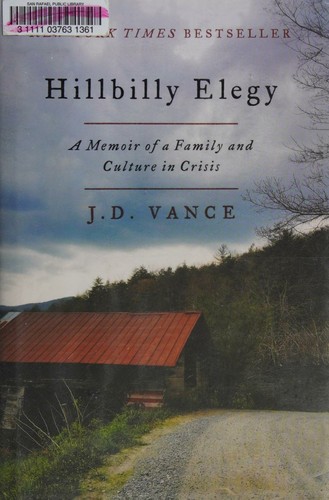
Hillbilly Elegy: A Memoir of a Family and Culture in Crisis
J. D. Vance
