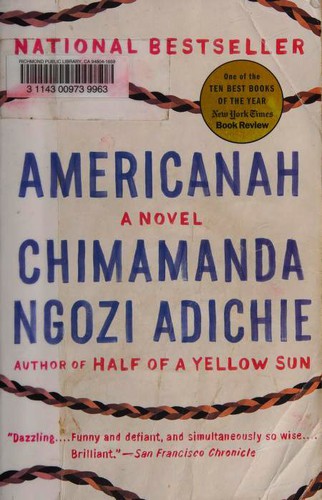
Talk to Americanah like its author wrote you back.
Get the ideas that fit your life — not generic summaries.
- Chat with the book
- Audiobook-style main ideas
- Adapts to your life and goals
- Helps you take action
What it argues
Americanah follows Ifemelu, a young Nigerian woman who leaves Lagos for America as a university student and spends fifteen years navigating a country that insists on categorizing her in ways Nigeria never did. The novel opens as she's preparing to return to Lagos — and to reconnect with her first love, Obinze, who himself spent years trying and failing to make a life in England before returning to Nigeria as a wealthy, unhappily married man.
Adichie's central argument is that Ifemelu becomes "Black" only in America. In Nigeria she was Igbo, or middle-class, or clever — but not Black in the American sense. The discovery of American race is the novel's intellectual engine, expressed partly through Ifemelu's blog, "Raceteenth, or Various Observations About American Blacks (Those Formerly Known as Negroes) by a Non-American Black." The blog entries, quoted at length, are among the sharpest writing about American racial dynamics in contemporary fiction — funny, angry, precise, and deliberately addressed to white readers who think they're past all this.
What it gets right
- 1.
Race is not a biological fact but a social assignment — Ifemelu's experience of becoming Black only in America is one of contemporary fiction's most effective dramatizations of this.
- 2.
The blog posts embedded in the novel function as a direct address to white readers, forcing a second perspective on the same events described in the narrative.
- 3.
Hair is the novel's central physical symbol: Ifemelu's decision to wear her natural hair becomes an act of self-recovery as much as style.
What it covers
Who wrote it
Chimamanda Ngozi Adichie was born in Nigeria in 1977 and grew up in Nsukka. Her novels include Purple Hibiscus, Half of a Yellow Sun, and Americanah, which won the National Book Critics Circle Award and the Chicago Tribune Heartland Prize. Her TED talks — "The Danger of a Single Story" and "We Should All Be Feminists" — have been widely translated and distributed. She is one of the most discussed literary voices on race, gender, and identity working today, and divides her time between Nigeria and the United States.
