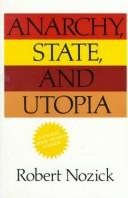
Anarchy, State, and Utopia by Robert Nozick is a 1974 philosophy book about political philosophy, individual rights, libertarianism. Individuals have rights so strong that no state may override them for redistributive ends. The minimal state — protecting against force, theft, and fraud — is the most that can be justified.
Summary
Anarchy, State, and Utopia is Robert Nozick's 1974 response to John Rawls and a foundational text of libertarian political philosophy. Nozick's central claim is that individuals have rights so strong that no state or collective may override them in the name of redistribution or social welfare. The minimal state — one limited to protecting against violence, theft, and fraud, and to enforcing contracts — is the most extensive state that can be justified. Any state that does more violates individual rights.
Nozick builds the case in three steps. First, he argues that even a minimal state can arise from a state of nature through a morally acceptable process (the invisible-hand theory of the state), without anyone violating rights. Second, he argues against more extensive states. His entitlement theory of justice holds that a distribution is just if it arose through just acquisition and just transfers, regardless of the pattern that results. Patterned principles of justice — like Rawls's difference principle — require continuous interference with voluntary transactions to maintain their preferred outcome. The famous Wilt Chamberlain argument illustrates this: if people freely give small amounts to watch Chamberlain play, the resulting unequal distribution is just, even though it disrupts any egalitarian pattern.
Third, Nozick explores utopia. Rather than a single blueprint for the ideal society, he envisions a framework of communities in which individuals can freely join groups with different rules. The minimal state is the only structure that respects this diversity without imposing a single vision on everyone.
The book is demanding and argumentative. Nozick does not shy from thought experiments and abstract arguments, and he is honest about complications in his own view. Critics have challenged his account of initial acquisition (can anyone justly acquire unowned resources?), the baseline for the Lockean proviso, and whether his framework accommodates the historical injustices that shaped actual property holdings. The arguments remain live and contested. As a statement of the case that individual rights constrain collective action, it has no modern equal.
Talk to Anarchy, State, and Utopia like its author wrote you back.
Get the ideas that fit your life — not generic summaries.
- Chat with the book
- Audiobook-style main ideas
- Adapts to your life and goals
- Helps you take action
Key takeaways
- 1.
Individuals have rights so strong that no state may override them for redistributive ends. The minimal state — protecting against force, theft, and fraud — is the most that can be justified.
- 2.
The entitlement theory of justice says distributions are just based on how they arose, not on whether they match a preferred pattern.
- 3.
The Wilt Chamberlain argument: any patterned distribution will be disrupted by free voluntary exchange, meaning enforcing a pattern requires continuous violations of liberty.
- 4.
A minimal state can arise legitimately from a state of nature through an invisible-hand process without anyone intentionally creating it or violating rights.
- 5.
Nozick's Lockean proviso allows appropriation of unowned things as long as the position of others is not worsened — but what counts as 'worsened' is genuinely contested.
- 6.
Taxation of earnings is, for Nozick, morally equivalent to forced labor: the state is claiming a portion of a person's work without consent.
- 7.
Utopia need not be a single ideal society. The minimal state provides a framework in which communities with different ideals can coexist through free association.
- 8.
Historical injustice complicates entitlement theory: actual property holdings trace back to force and fraud, not purely voluntary exchange, which Nozick acknowledges without fully resolving.
Discussion questions
Use these on your own, with a book club, or as chat starters in Superbook. Book club version, ready to copy or print →
- 1.
Nozick argues taxation of earnings is akin to forced labor. Is that analogy persuasive, or does it rest on assumptions about property that most people would reject?
- 2.
The Wilt Chamberlain argument says voluntary exchanges undermine any patterned distribution. Does this argument feel like a reductio of egalitarianism, or does it expose a genuine tension in redistributive theories?
- 3.
If a minimal state can arise through an invisible-hand process, does that mean we have obligations to it? What grounds political obligation for Nozick?
- 4.
Nozick's entitlement theory is sensitive to history. Given that most actual property holdings trace through conquest and theft, how do you think Nozick's framework should handle rectification?
- 5.
Is Nozick's utopia — a framework for many communities living by different rules — genuinely utopian, or does it just reproduce whatever power disparities already exist?
- 6.
Rawls's difference principle requires improving the position of the worst off. Nozick says this violates rights. Who do you find more persuasive, and why?
- 7.
Do individuals ever have a legitimate claim against others simply by virtue of need, or are rights purely negative for you?
- 8.
Nozick's self-ownership principle — that you own yourself and your labor — is the foundation of his argument. What follows if you reject it, even slightly?
- 9.
The book was published during a political era shaped by Great Society programs and welfare expansion. How do you read the argument differently with a half-century of hindsight?
- 10.
What role does consent play in Nozick's framework? Is consent a sufficient basis for justice in a world of vastly unequal starting positions?
- 11.
If people in Nozick's utopia join a community with collectivist rules — high taxes, redistribution, shared ownership — is that community itself permissible within his framework?
- 12.
Nozick's minimal state still requires a monopoly on force. Does that monopoly itself require justification that he doesn't fully provide?
Themes
Frequently asked questions
-
What is Anarchy, State, and Utopia mainly arguing?
That individual rights are so fundamental that only a minimal state — protecting against force, theft, and fraud — can be justified. Any redistributive state violates rights, even with good intentions.
-
Is Anarchy, State, and Utopia hard to read?
Yes, it is demanding. Nozick writes analytically and packs his chapters with thought experiments and formal arguments. Readers without philosophy training will need patience, but the core arguments in Part II are accessible if read slowly.
-
How does Nozick differ from Rawls?
Rawls asks what principles people would choose behind a veil of ignorance and supports redistribution to help the worst off. Nozick says historical process determines what's just — voluntary exchanges are just regardless of their pattern — and that redistribution requires coercion that violates rights.
-
Who should read this book?
Anyone interested in political philosophy, the foundations of libertarianism, or debates about redistribution and state power. It's essential reading alongside Rawls for understanding the terms of the political philosophy debate since the 1970s.
-
Does Nozick address historical injustice in property holdings?
Yes, but incompletely. He acknowledges the rectification problem — that actual holdings trace back to force and fraud — and proposes a principle of rectification, but leaves the details underdeveloped, which critics regard as a significant gap.