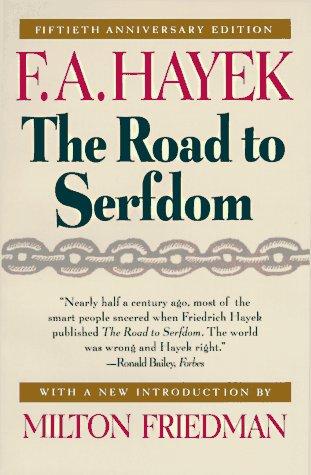
The Road to Serfdom by F. A. Hayek is a 1944 politics book about liberalism, central planning, totalitarianism. Central economic planning requires concentrating authority in ways that are structurally incompatible with individual freedom and the rule of law.
Summary
The Road to Serfdom, published in 1944, is Friedrich Hayek's argument that central economic planning is incompatible with political freedom and will, regardless of intent, produce a form of totalitarianism. Writing during the Second World War, Hayek was primarily addressing the British and American left, which had absorbed socialist ideas about state direction of the economy as a progressive alternative to both fascism and unregulated capitalism. His central contention was that these critics misunderstood the relationship between fascism and socialism: both required the same concentration of economic power, and the power concentrated for good ends would inevitably be turned to oppressive ones.
Hayek's argument proceeds from his analysis of dispersed knowledge. No central authority can possess the information necessary to coordinate a complex economy because the relevant knowledge is distributed across millions of individual decisions, preferences, and local circumstances. Prices in a market system aggregate and transmit this information in ways no planner can replicate. Central planning therefore requires both the substitution of one authority's values for the diverse values of individuals and the suppression of the spontaneous order that actually makes economic coordination possible.
The political logic follows: planning requires authority, authority requires coercion, and coercion applied systematically to economic life cannot be limited to economic life. The characteristics Hayek identifies in Nazi Germany — the displacement of the rule of law by administrative discretion, the subordination of minority interests to collective goals, the rise of the "worst" to positions of power because they are least constrained by moral scruple — follow, he argues, from the structure of central planning itself, not from the particular ideology of the planners.
Hayek is careful to distinguish his argument from opposition to all state action. He supports a robust social safety net, competition law, and public goods provision. His target is comprehensive economic direction, not the welfare state. This nuance has often been lost in both the enthusiastic embrace of the book by market fundamentalists and in critiques that reduce it to a crude defense of laissez-faire. The book remains contested and influential: it helped shape postwar economic liberalism, was cited by Thatcher and Reagan, and continues to frame debates about the state's role in economic life.
Talk to The Road to Serfdom like its author wrote you back.
Get the ideas that fit your life — not generic summaries.
- Chat with the book
- Audiobook-style main ideas
- Adapts to your life and goals
- Helps you take action
Key takeaways
- 1.
Central economic planning requires concentrating authority in ways that are structurally incompatible with individual freedom and the rule of law.
- 2.
No planning authority can possess the dispersed local knowledge that price systems aggregate and transmit; central plans substitute one authority's values and information for the diversity of millions.
- 3.
Fascism and socialism, despite their apparent opposition, share a structural similarity: both require comprehensive state control of economic life.
- 4.
The displacement of the rule of law by administrative discretion is not an abuse of planning but an inherent consequence of it — planners need discretion because rules cannot anticipate every case.
- 5.
Power over economic life cannot be reliably limited to economic life; those who control the means of production acquire leverage over every dimension of existence.
- 6.
Collective goals that sound noble in the abstract — social justice, the common good — are in practice defined by whoever holds power, and coercion to pursue them is always coercion on behalf of a particular group's values.
- 7.
Hayek supports a social safety net, public health, and competition regulation; his argument is against comprehensive planning, not against welfare or state institutions per se.
- 8.
The market order is not designed by anyone and is not the expression of any values; it coordinates the plans of individuals with different and often incompatible ends, which is precisely its value.
Discussion questions
Use these on your own, with a book club, or as chat starters in Superbook. Book club version, ready to copy or print →
- 1.
Hayek argues that planning and individual freedom are fundamentally incompatible. Do you find this a structural argument or an empirical one — and does the distinction matter?
- 2.
The book was addressed to progressive democrats who wanted planning without fascism. How persuasive is Hayek's claim that the two lead to the same destination?
- 3.
Hayek distinguishes between a safety net and comprehensive planning. Where in practice do you think that line runs, and has political history vindicated or complicated his claim that the line holds?
- 4.
The dispersed knowledge argument is Hayek's most technical claim. What does it imply for policy areas where information is highly concentrated, such as finance or pharmaceuticals?
- 5.
Hayek says the worst rise to the top under totalitarian planning. Does the empirical history of 20th-century authoritarian states support or complicate that claim?
- 6.
The Road to Serfdom was embraced by Thatcher, Reagan, and the neoliberal right in ways Hayek may not have fully endorsed. How do you evaluate a book by the uses to which it has been put?
- 7.
What is the relationship between the rule of law and economic freedom in Hayek's argument? Can one exist without the other?
- 8.
Hayek writes that collective goals are always in practice the goals of whoever holds power. Is that an argument against collective goals or against unchecked power?
- 9.
The book treats the market as a spontaneous order that no one designs. What does that framing exclude from the analysis — what features of markets are not spontaneous?
- 10.
How does Hayek's argument look from the perspective of a country where market failure, rather than state overreach, is the primary political problem?
- 11.
Is Hayek's diagnosis of what went wrong in Germany applicable to other political contexts, or was it shaped too specifically by the interwar European experience?
- 12.
Reading this in 2026: which of Hayek's warnings seem prescient, and which seem like products of a historical moment that has passed?
Themes
Frequently asked questions
-
What is The Road to Serfdom arguing?
That central economic planning necessarily leads to political authoritarianism, regardless of the intentions of the planners, because it requires a concentration of power and a displacement of the rule of law that cannot be safely limited once established.
-
Is The Road to Serfdom still relevant?
Yes, as an intellectual history document and as a framework for thinking about the relationship between economic and political freedom. Its specific 1944 target — British socialist planning — is dated, but the underlying arguments about knowledge, power, and the rule of law remain live in contemporary policy debates.
-
Does Hayek oppose all government intervention?
No. Hayek explicitly supports a social safety net, public health measures, and competition regulation. His argument is against comprehensive central planning of economic life, not against welfare provision or state institutions. This distinction is frequently missed by both his admirers and his critics.
-
How long is The Road to Serfdom?
Around 260 pages in standard editions, roughly six hours at average reading pace. The prose is dense but lucid; Hayek wrote it for a general audience, and it reads more accessibly than his technical economics.
-
Who should read The Road to Serfdom?
Anyone interested in the intellectual foundations of economic liberalism and the 20th-century debate about markets versus planning. It is essential reading for understanding postwar political economy, and valuable regardless of whether you find the argument ultimately persuasive.