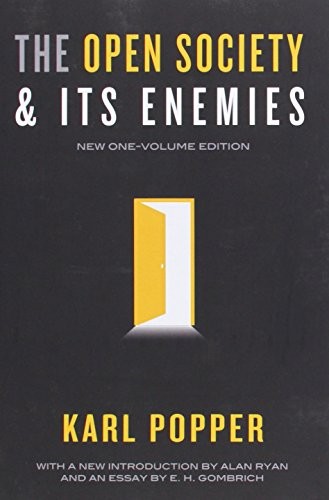
The Open Society and Its Enemies by Karl Popper is a 1945 philosophy book about democracy, totalitarianism, critical rationalism. The open society tolerates criticism and corrects its mistakes. The closed society subordinates individuals to a collective destiny and cannot self-correct without violence.
Summary
Karl Popper wrote The Open Society and Its Enemies during World War II, and the wartime context is inseparable from its argument. Published in 1945, the book is both a philosophical attack on totalitarianism and a defense of liberal democracy grounded in Popper's theory of knowledge. His central claim is that any society claiming to move toward a fixed historical destiny — whether Platonic, Hegelian, or Marxist — will tend toward authoritarianism because it subordinates living individuals to an abstraction. The open society, by contrast, tolerates dissent, corrects its mistakes, and makes no promises about where history is heading.
The book is divided into two volumes. The first targets Plato, arguing that the Republic is not the liberal utopia some admirers believed but a blueprint for a closed, rigid hierarchy in which the philosopher-king rules by deception and citizens are assigned permanent roles. Popper reads Plato's hostility to democracy as an aristocratic reaction to the social disruption of Athens, not a disinterested philosophical conclusion. This reading was immediately controversial and remains so — Plato scholars still argue about how literally the Republic was meant to be taken — but Popper's point is less about Plato's personal intentions than about the template that idealist politics provides.
The second volume trains the same method on Hegel and Marx. Popper coins the term "historicism" for the belief that history follows inexorable laws and that knowing those laws justifies radical action to hasten the outcome. He argues that both Hegel's Prussian statism and Marx's revolutionary socialism are forms of historicism, and that historicist thinking is not just wrong but unfalsifiable — and therefore, in Popper's framework, unscientific. His alternative is "piecemeal social engineering": fixing specific social problems through trial and error rather than pursuing total transformation.
Two features of the book reward close attention. First, Popper's treatment of Marx is more nuanced than his treatment of Hegel; he acknowledges Marx's genuine humanist concerns while arguing the theoretical apparatus undermines them. Second, his defense of the open society is explicitly procedural, not substantive. He is not arguing that liberal democracy produces better outcomes in every case, but that it uniquely allows bad decisions to be reversed without bloodshed. That argument, written as fascism was collapsing and Stalinism was expanding, has aged better than most of its contemporaries.
Talk to The Open Society and Its Enemies like its author wrote you back.
Get the ideas that fit your life — not generic summaries.
- Chat with the book
- Audiobook-style main ideas
- Adapts to your life and goals
- Helps you take action
Key takeaways
- 1.
The open society tolerates criticism and corrects its mistakes. The closed society subordinates individuals to a collective destiny and cannot self-correct without violence.
- 2.
Historicism — the belief that history follows discoverable laws pointing toward a fixed goal — is the intellectual foundation of totalitarianism, whether fascist or Marxist.
- 3.
Popper reads Plato's Republic as a totalitarian blueprint: a rigid class hierarchy, philosopher-kings who rule by noble lies, and hostility to change.
- 4.
Hegel's philosophy of the state and Marx's historical materialism both derive from the same mistake: treating the collective as more real than the individuals who compose it.
- 5.
Piecemeal social engineering — solving specific problems through reversible experiments — is the only approach compatible with both scientific method and political freedom.
- 6.
The paradox of tolerance: a society that is tolerant without limit will eventually be seized by the intolerant. Freedom requires defending itself.
- 7.
Marx's economic analysis was serious and his humanist concerns genuine, but the historical inevitability he attached to them corrupted both the theory and its practical consequences.
- 8.
Science advances by conjecture and refutation; politics should too. A democracy's great advantage is that it allows governments to be replaced without violence.
Discussion questions
Use these on your own, with a book club, or as chat starters in Superbook. Book club version, ready to copy or print →
- 1.
Popper argues that Plato's ideal state is totalitarian at heart. Does reading the Republic as a political blueprint rather than a philosophical exercise change how you assess it?
- 2.
What does Popper mean by historicism, and can you think of contemporary movements that fit his definition?
- 3.
The paradox of tolerance states that unlimited tolerance must lead to the disappearance of tolerance. How should an open society draw that line in practice?
- 4.
Popper distinguishes piecemeal social engineering from utopian social engineering. Is that distinction meaningful when the problems are large-scale, like climate change or poverty?
- 5.
His critique of Marx distinguishes between Marx's intentions and the consequences of his theory. Is that a fair way to evaluate a political thinker?
- 6.
Popper defends liberal democracy procedurally: it allows bad rulers to be removed without violence. Is that a sufficient defense, or does democracy need a stronger substantive justification?
- 7.
The book was written in response to fascism and Nazism. Does it map onto the political threats you see in the world today, or does it miss something?
- 8.
Popper accuses Hegel of obscurantism — deliberate vagueness to make ideas impossible to falsify. Is that a fair characterization, or does it miss what Hegel was doing?
- 9.
The open society idea assumes that tolerating dissent is better in the long run than suppressing it. Are there domains — public health, national security — where you'd push back on that?
- 10.
Popper's own politics were center-left. Does his critique of socialism sit in tension with his political sympathies, or does he thread the needle convincingly?
- 11.
Which argument in the book felt most dated, and which felt most urgent given the political moment you're reading it in?
- 12.
Popper places enormous weight on the freedom to criticize. What institutions or norms in your own society do you rely on to preserve that freedom?
Themes
Frequently asked questions
-
Is The Open Society and Its Enemies still relevant today?
Yes, though it demands patience. Popper's core arguments about historicism and the structural dangers of closed societies apply to any political era where leaders claim to know where history must go. The Plato sections feel more academic, but the chapters on Hegel and Marx have direct contemporary resonance.
-
How long does it take to read The Open Society and Its Enemies?
It is a long book — over 700 pages in the standard two-volume edition — and the writing is dense. Expect 15 to 20 hours for a careful reading. Many readers work through it in sections, treating the two volumes as separate books.
-
What is Popper's main argument in simple terms?
Societies that claim to be building toward a fixed historical destiny tend to become authoritarian because they cannot tolerate dissent without threatening the whole project. Open societies that admit uncertainty and allow course correction are more resilient and more humane, even if they're less tidy.
-
Do I need a philosophy background to read this book?
A basic familiarity with Plato and Marx helps, but Popper is unusually readable for a major philosopher. He explains the positions he's attacking clearly before critiquing them. Readers with no philosophy background have found it accessible, especially the second volume on Hegel and Marx.
-
What is the paradox of tolerance Popper describes?
If a society extends tolerance even to those who would use it to destroy tolerance itself, tolerance will eventually be eliminated. Popper argued that the open society must be prepared to suppress movements that actively work to overthrow it, which is why unlimited tolerance is self-defeating.
Similar books
Sapiens: A Brief History of Humankind
Yuval Noah Harari
The Rise and Fall of the Third Reich
William L. Shirer
Enlightenment Now
Steven Pinker
The Better Angels of Our Nature
Steven Pinker
