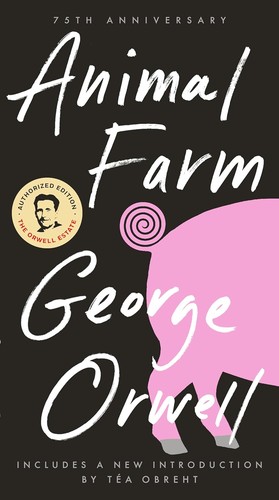
Talk to Animal Farm like its author wrote you back.
Get the ideas that fit your life — not generic summaries.
- Chat with the book
- Audiobook-style main ideas
- Adapts to your life and goals
- Helps you take action
What it argues
When the animals of Manor Farm drive out their human farmer and establish a republic governed by the principle that all animals are equal, the revolution feels like liberation. The pigs, being the most literate, take charge of planning and administration. Within a few years, the farm is indistinguishable from the tyranny it replaced — and the commandment has been revised to read "All animals are equal, but some animals are more equal than others." Published in 1945 after Orwell struggled to find a publisher willing to take it, Animal Farm is one of the most effective political allegories ever written.
The target of the satire is Stalinism specifically — Old Major is Marx/Lenin, Napoleon is Stalin, Snowball is Trotsky, the dogs are the secret police — but Orwell was writing about something more universal: how revolutions get captured, how language is weaponized to justify what it was supposed to prevent, and how the oppressed can become oppressors without noticing. The animals are not stupid. They remember the original commandments. But they can be confused by authority, shamed out of their memories, and worn down by overwork until the will to resist evaporates.
What it gets right
- 1.
Revolutions tend to produce new ruling classes rather than eliminate ruling classes. The pigs become what they overthrew because the logic of power, not the identity of the powerful, is what changes last.
- 2.
Squealer's propaganda works not by lying outright but by managing memory — changing records, revising commandments incrementally, and shaming animals who question the narrative.
- 3.
Boxer's loyalty — 'Napoleon is always right' — is the novel's most tragic element. Devotion without critical thinking is exactly what authoritarian systems require to function.
What it covers
Who wrote it
George Orwell (1903–1950) was a British author and journalist whose work combined sharp political analysis with direct, unadorned prose. He drew on his experiences as a colonial police officer in Burma, a fighter in the Spanish Civil War, and a journalist living in poverty for his early books, including Homage to Catalonia and Down and Out in Paris and London. Animal Farm (1945) and Nineteen Eighty-Four (1949), published in the last five years of his life, made him one of the most cited political writers of the twentieth century.
