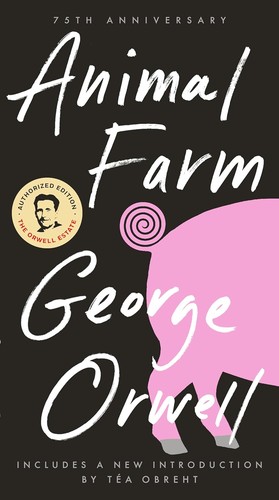
Animal Farm by George Orwell is a 1945 literary fiction book about political corruption, propaganda and language, revolution and betrayal. Revolutions tend to produce new ruling classes rather than eliminate ruling classes. The pigs become what they overthrew because the logic of power, not the identity of the powerful, is what changes last.
Summary
When the animals of Manor Farm drive out their human farmer and establish a republic governed by the principle that all animals are equal, the revolution feels like liberation. The pigs, being the most literate, take charge of planning and administration. Within a few years, the farm is indistinguishable from the tyranny it replaced — and the commandment has been revised to read "All animals are equal, but some animals are more equal than others." Published in 1945 after Orwell struggled to find a publisher willing to take it, Animal Farm is one of the most effective political allegories ever written.
The target of the satire is Stalinism specifically — Old Major is Marx/Lenin, Napoleon is Stalin, Snowball is Trotsky, the dogs are the secret police — but Orwell was writing about something more universal: how revolutions get captured, how language is weaponized to justify what it was supposed to prevent, and how the oppressed can become oppressors without noticing. The animals are not stupid. They remember the original commandments. But they can be confused by authority, shamed out of their memories, and worn down by overwork until the will to resist evaporates.
The book works as propaganda analysis as much as political allegory. Squealer, the pig whose job is to explain the leadership's decisions to the other animals, is one of literature's most memorable portraits of how information is managed in authoritarian systems — through selective memory, inflated threat, and the weaponization of loyalty. Orwell was also writing before television and social media made these techniques ubiquitous; the book now reads as a primer that explains more than it intended.
At 30,000 words, Animal Farm is more novella than novel, readable in two hours. That brevity is part of its power — Orwell doesn't give the allegory room to become complicated. Some readers find it too schematic, the animals too obviously symbolic, the ending too neat in its horror. But as an entry point for thinking about how political systems corrupt themselves, and as a portrait of what it looks like when it happens from the inside, it remains essential and efficient.
Talk to Animal Farm like its author wrote you back.
Get the ideas that fit your life — not generic summaries.
- Chat with the book
- Audiobook-style main ideas
- Adapts to your life and goals
- Helps you take action
Key takeaways
- 1.
Revolutions tend to produce new ruling classes rather than eliminate ruling classes. The pigs become what they overthrew because the logic of power, not the identity of the powerful, is what changes last.
- 2.
Squealer's propaganda works not by lying outright but by managing memory — changing records, revising commandments incrementally, and shaming animals who question the narrative.
- 3.
Boxer's loyalty — 'Napoleon is always right' — is the novel's most tragic element. Devotion without critical thinking is exactly what authoritarian systems require to function.
- 4.
The dogs are raised from puppies by Napoleon to be enforcers. Orwell understood that repressive apparatus doesn't need ideology; it needs early training and dependence.
- 5.
The pigs began by believing in the revolution. Orwell doesn't portray them as cynical from the start — the corruption is gradual, which makes it harder to resist and more realistic.
- 6.
The final image — humans and pigs indistinguishable at the card table — is Orwell's clearest statement that collaboration between oppressors, once power is established, crosses ideological lines.
- 7.
Language is the primary instrument of control. Once the pigs control what the commandments say, they control what the animals remember and therefore what they believe.
Discussion questions
Use these on your own, with a book club, or as chat starters in Superbook. Book club version, ready to copy or print →
- 1.
The animals' revolution begins with genuine idealism. At what point did it become irreversible that the pigs would end up in charge? Was it avoidable?
- 2.
Boxer believes in Napoleon absolutely and works himself to death for the farm. Is he a hero, a victim, or something more complicated?
- 3.
Squealer convinces the animals they remember things wrong. Which of his specific techniques — false statistics, invoking Snowball as threat, revising commandments — feels most recognizable in contemporary political life?
- 4.
The other animals suspect things are wrong but fail to act. What stops them? Fear, confusion, exhaustion, or something else?
- 5.
Benjamin the donkey sees through the pigs the whole time but does nothing. Is he wise, cowardly, or just honest about what one animal can do?
- 6.
Old Major's speech at the beginning is genuinely moving. Does the novel think his original vision was flawed, or just that its implementation was captured?
- 7.
Orwell struggled to get Animal Farm published because British publishers in 1944 didn't want to criticize a wartime ally. Does knowing that context change how you read the book?
- 8.
The novel ends without hope or revolt. Does that feel true to you about how authoritarian capture works — or is Orwell being too pessimistic?
- 9.
Who in the story is most responsible for the revolution's failure: the pigs who corrupted it, the animals who didn't resist, or the design of the system itself?
- 10.
Animal Farm is often assigned in high school as anti-communist propaganda. Does it work the same way if you apply its logic to non-communist authoritarian systems?
- 11.
Is there an animal you identified with? What does your answer say about where you see yourself in political structures?
Themes
Frequently asked questions
-
What is Animal Farm actually about?
It's an allegory for the Russian Revolution and the rise of Stalinism, told through farm animals who overthrow their human owner and create an egalitarian republic that is gradually transformed into a dictatorship by the pigs. More broadly, it's about how revolutions get captured by new ruling classes.
-
How long does it take to read Animal Farm?
About two hours. It's a novella of roughly 30,000 words, written in clear, direct prose with no difficult passages. Many readers finish it in a single sitting.
-
Is Animal Farm too simple to be worth reading as an adult?
The allegory is transparent, yes. But the precision of Squealer's propaganda, the psychology of Boxer's loyalty, and the mechanics of incremental commandment revision are more sophisticated than they appear in summary. It's worth reading slowly and asking which techniques are familiar.
-
Why couldn't Orwell find a publisher for Animal Farm?
Several major British publishers rejected it in 1944 because the Soviet Union was a wartime ally and the book was an obvious attack on Stalin. T. S. Eliot at Faber famously rejected it. It was finally published in 1945 by a small press.
-
Who shouldn't read Animal Farm?
Those who already know the story well and find the allegory too schematic — readers who want psychological complexity or narrative surprise will find little here. It's a pamphlet in the shape of a fable, and its virtues are exactly those of a pamphlet.