Science fiction · Book club
Annihilation book club questions
Here are 12 book club questions for Annihilation by Jeff VanderMeer, ordered to open easily and end somewhere worth arguing about. Copy them, print them, or bring them up one at a time.
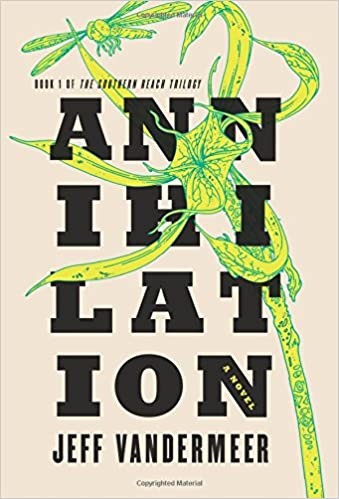
A team of four unnamed women — the biologist, the anthropologist, the surveyor, and the psychologist — enter Area X, a forbidden coastal wilderness where something has gone wrong for decades.
Jeff VanderMeer · 2014 · 4h 45m
Full summary and key takeaways →The 12 questions
- 1.
The biologist is already alienated from human connection before she enters Area X. Does Area X find something in her, or does it put something into her?
- 2.
VanderMeer never names his characters. Does that choice serve the themes, or did you find it distancing?
- 3.
The Southern Reach agency is supposed to be investigating and controlling Area X. By the end of the book, do you trust that it understands anything about what's happening?
- 4.
The tower goes underground. The words are alive. The Crawler exists. VanderMeer withholds explanation. Does not knowing what these things are make them more frightening or less?
- 5.
The biologist's marriage is told in retrospect, across the novel. Did you understand why it failed? Did the novel want you to sympathize with her, with her husband, or with neither?
- 6.
Annihilation is sometimes shelved as science fiction and sometimes as horror. Which did it feel like to you, and does the distinction matter?
- 7.
VanderMeer was influenced by ecological horror and by the idea of nature as genuinely alien. Is Area X nature, or something else?
- 8.
The biologist says she was already 'contaminated' before she knew it. Does that change your reading of everything she reports before that admission?
- 9.
The book ends without resolution. Does the Southern Reach trilogy's continuation in Authority and Acceptance make Annihilation feel like a fragment, or does it stand alone?
- 10.
Several characters are 'changed' by Area X in different ways. What does the variety of changes suggest — is Area X acting on what's already there, or imposing something new?
- 11.
The prose stays calm and clinical while describing impossible things. What effect did that tonal control have on you as a reader?
- 12.
Is this a novel about grief? A marriage? Environmental anxiety? Climate change? All of those? None?
How to run the discussion
- Pick six to eight, not all of them. An hour of real discussion covers fewer questions than anyone expects, and racing the list is what makes a book club feel like homework.
- Open with what people noticed, not what they concluded. Asking for a verdict first hardens opinions before anyone has heard each other.
- Let the disagreement run. The questions below that split a room are the ones worth the time; the ones everyone answers the same way can be skipped.
- Ask the quiet person a specific question. A direct, narrow question is far easier to answer than an open invitation to contribute.
Themes worth steering toward
If the conversation stalls, these are the threads that usually restart it.
Common questions
What are good book club questions for Annihilation?
Here are 12 book club questions for Annihilation by Jeff VanderMeer, ordered to open easily and end somewhere worth arguing about. The strongest openers ask what each reader noticed rather than what they concluded, and the discussion usually turns on the unknown and unknowable, identity dissolution, nature reclaiming the human.
How long should a book club discussion of Annihilation last?
Most groups run 60 to 90 minutes of actual discussion. That is roughly six to eight questions, not all of them, so pick the ones that suit your group rather than working down the list in order.
What are the main themes in Annihilation?
The unknown and unknowable, Identity dissolution, Nature reclaiming the human, Institutional trust, Memory and unreliability. Those are the threads most likely to divide a room, which makes them the useful places to steer a discussion that has gone quiet.
Picking the next one? See books like Annihilation or questions for other book club picks.
