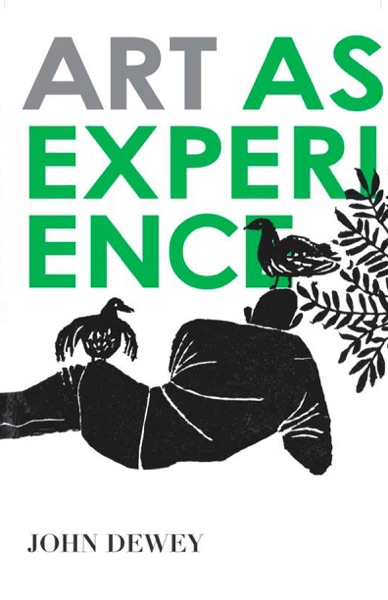
Talk to Art as Experience like its author wrote you back.
Get the ideas that fit your life — not generic summaries.
- Chat with the book
- Audiobook-style main ideas
- Adapts to your life and goals
- Helps you take action
What it argues
Art as Experience, published in 1934, is John Dewey's attempt to rescue aesthetics from the museum pedestal and return it to ordinary life. Dewey argues that art is not a rarefied category of precious objects but the heightened form of any experience that achieves completion — that has a quality of integration, form, and meaning. His starting point is the living creature in its environment: whenever an organism moves through tension to resolution, the possibility of aesthetic experience exists. The artist refines and concentrates what ordinary experience only partly achieves.
The central distinction Dewey draws is between experience as inert endurance and "an experience" — a sequence with its own integrity, a beginning that drives toward an end that consummates it. He uses the phrase "having an experience" to describe moments when everything comes together: the meal that was exactly right, the conversation that resolved something real, the walk that felt complete. Art is the deliberate crafting of such experiences for others. The work of art is not the physical object but the experience it makes possible.
What it gets right
- 1.
Aesthetic experience is not confined to fine art — it is the fulfillment of any experience that achieves form, integrity, and completion.
- 2.
The distinction between 'art' and 'craft' or 'applied design' is historically contingent, not essential. Dewey regards it as a symptom of economic separation rather than a philosophical truth.
- 3.
The 'museum conception of art' severs objects from the live contexts that gave them meaning, making both art and ordinary life poorer.
What it covers
Who wrote it
John Dewey (1859–1952) was an American philosopher, psychologist, and educational reformer whose influence on twentieth-century thought was immense. He was a central figure in the pragmatist tradition alongside William James and Charles Sanders Peirce, and his work in philosophy of education reshaped schooling in the United States. Art as Experience, delivered as the first William James Lectures at Harvard in 1931, represents his sustained treatment of aesthetics. His other major works include Experience and Nature, Democracy and Education, and Logic: The Theory of Inquiry.
