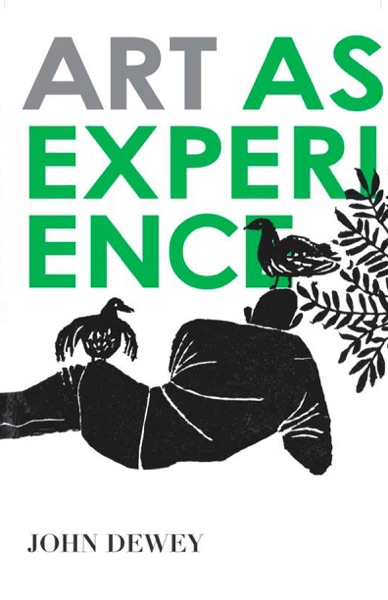
Art as Experience by John Dewey is a 1934 philosophy book about aesthetics, experience, perception. Aesthetic experience is not confined to fine art — it is the fulfillment of any experience that achieves form, integrity, and completion.
Summary
Art as Experience, published in 1934, is John Dewey's attempt to rescue aesthetics from the museum pedestal and return it to ordinary life. Dewey argues that art is not a rarefied category of precious objects but the heightened form of any experience that achieves completion — that has a quality of integration, form, and meaning. His starting point is the living creature in its environment: whenever an organism moves through tension to resolution, the possibility of aesthetic experience exists. The artist refines and concentrates what ordinary experience only partly achieves.
The central distinction Dewey draws is between experience as inert endurance and "an experience" — a sequence with its own integrity, a beginning that drives toward an end that consummates it. He uses the phrase "having an experience" to describe moments when everything comes together: the meal that was exactly right, the conversation that resolved something real, the walk that felt complete. Art is the deliberate crafting of such experiences for others. The work of art is not the physical object but the experience it makes possible.
Dewey is a relentless critic of what he calls the museum conception of art — the idea that genuine aesthetic objects exist apart from everyday practice and that fine art is separate in kind from craft, decoration, or applied design. He traces this separation to economic forces: objects looted from defeated cultures end up in galleries, stripped of their original context and meaning. The separation impoverishes both art and daily life. When cooking, conversation, or the design of a street can be fully experienced, they are already aesthetic in Dewey's sense.
The final sections deal with form, expression, and the specific qualities of different arts — painting, architecture, literature, music. These chapters are more technical and repay re-reading. Dewey's prose is dense and often demands patience, but the underlying argument is generous: that every human being is capable of aesthetic experience, that the arts are a culmination of ordinary human capacities rather than a gift to the specially endowed, and that democratic culture depends on keeping that connection alive.
Talk to Art as Experience like its author wrote you back.
Get the ideas that fit your life — not generic summaries.
- Chat with the book
- Audiobook-style main ideas
- Adapts to your life and goals
- Helps you take action
Key takeaways
- 1.
Aesthetic experience is not confined to fine art — it is the fulfillment of any experience that achieves form, integrity, and completion.
- 2.
The distinction between 'art' and 'craft' or 'applied design' is historically contingent, not essential. Dewey regards it as a symptom of economic separation rather than a philosophical truth.
- 3.
The 'museum conception of art' severs objects from the live contexts that gave them meaning, making both art and ordinary life poorer.
- 4.
Every experience has an aesthetic dimension when it moves from tension to resolution with a quality of wholeness. A meal, a conversation, or a problem solved can all have this quality.
- 5.
Expression in art is not the venting of pre-formed emotions but the transformation of raw impulse into meaning through a medium. The medium disciplines and clarifies feeling.
- 6.
Rhythm, balance, and form in art are not arbitrary conventions but refinements of pervasive qualities in natural and human experience — the pulse of organisms in their environments.
- 7.
The spectator or reader must recreate the work of art through active, imaginative engagement, not passive reception. Aesthetic experience is inherently participatory.
- 8.
Democratic culture depends on art remaining connected to common experience. When art becomes the exclusive possession of cultivated elites, both art and democracy suffer.
Discussion questions
Use these on your own, with a book club, or as chat starters in Superbook. Book club version, ready to copy or print →
- 1.
Dewey argues that the museum context distorts our experience of art. Can you think of a work you've encountered outside a formal setting that felt more alive as a result?
- 2.
What in your own daily life has come closest to what Dewey calls 'an experience' — something with a genuine beginning, development, and consummation?
- 3.
Dewey refuses to separate fine art from craft and design. Where do you draw that line, if at all, and on what grounds?
- 4.
He writes that expression transforms impulse through a medium rather than simply releasing it. How does that apply to a creative activity you practice?
- 5.
Is the heightened experience Dewey describes available to everyone, or does it require education and training? What's your honest view?
- 6.
Dewey links the isolation of art from ordinary life to economic and political forces. Does that argument seem convincing when you look at contemporary art institutions?
- 7.
He claims aesthetic experience in architecture is inseparable from how a building is actually used and inhabited. Think of a building that has moved you — what made it work?
- 8.
The book was written in 1934. What has changed in mass culture and media since then that Dewey could not have anticipated, and how does it affect his argument?
- 9.
Dewey insists that the spectator must actively recreate the work, not passively receive it. What does that ask of us as audiences of film, music, or literature?
- 10.
Which of the arts do you think is most fully explained by Dewey's framework? Which fits least well, and why?
- 11.
If Dewey is right that democratic culture needs art connected to common experience, what practical implications does that have for how arts institutions should operate?
- 12.
His prose is notoriously difficult. Did the difficulty itself affect your experience of the argument, and what does that suggest about form and content?
Themes
Frequently asked questions
-
Is Art as Experience worth reading?
For anyone seriously interested in aesthetics, philosophy of mind, or cultural criticism, yes. It remains one of the most ambitious attempts to ground the experience of art in general human experience rather than in formal theory. The difficulty is real — Dewey's prose is dense — but the argument rewards persistence.
-
How hard is Art as Experience to read?
It is genuinely demanding. Dewey writes in long, heavily qualified sentences and builds his argument incrementally across chapters. Readers unfamiliar with philosophy will benefit from reading slowly, taking notes, and not expecting quick payoffs.
-
What is the main argument of Art as Experience?
That aesthetic experience is not a special category reserved for museums and concert halls but the fullest realization of ordinary experience. The arts refine and concentrate capacities all humans share, and separating art from everyday life impoverishes both.
-
Who should read this book?
Designers, artists, educators, and anyone who wants a philosophical foundation for thinking about beauty, form, and creative practice. It is also essential reading for philosophy students interested in American pragmatism and its take on culture.
-
What's the most useful idea in Art as Experience?
The concept of 'an experience' — a sequence that has its own integrity and consummation. It gives you a precise vocabulary for recognizing what makes any activity, not just art, feel complete and meaningful rather than merely endured.