Talk to Articulating Design Decisions like its author wrote you back.
Get the ideas that fit your life — not generic summaries.
- Chat with the book
- Audiobook-style main ideas
- Adapts to your life and goals
- Helps you take action
Articulating Design Decisions, in detail
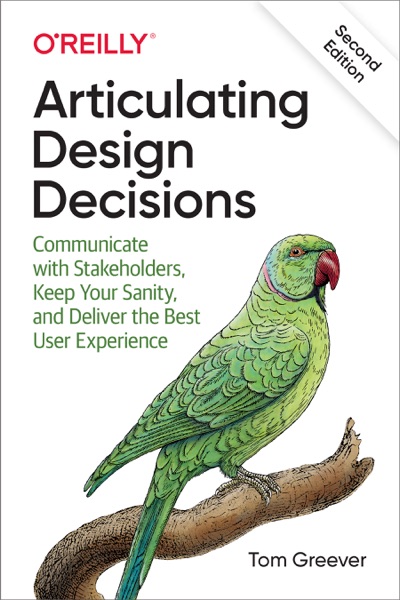
Articulating Design Decisions addresses a gap that most design education ignores: knowing how to make good decisions is necessary but not sufficient. You also have to be able to explain and defend them to people who don't share your visual vocabulary, aren't thinking about user experience, and have their own organizational goals driving their objections. Tom Greever, a UX director with experience working in cross-functional teams, wrote this book from the accumulation of those conversations and the patterns he observed in which explanations worked and which didn't.
The book's core argument is that design is inherently collaborative in organizations, and that treating design reviews as adversarial — where you defend your work against critics — is a losing strategy regardless of who is right. Greever reframes the stakeholder conversation as a shared problem-solving process. The designer's job in a meeting is not to win but to understand what the stakeholder is actually concerned about (which is often not what they're literally saying), find the legitimate interest behind the objection, and address that interest in terms the stakeholder can evaluate.
The practical framework Greever offers has three parts: listen, understand, respond. Much of the book is about the listening and understanding parts, which are often underdeveloped in designers who have been taught that rigorous process is self-justifying. He gives specific language for common situations — how to respond to a personal-taste objection, how to handle a stakeholder who wants to add something, how to deal with HiPPO dynamics (Highest Paid Person's Opinion) — and how to tell when feedback reflects a legitimate concern versus a bad instinct.
A second edition was published in 2024, updating the examples for contemporary tools and adding material on remote design review processes. The book is focused on product and digital design, but the core communication and negotiation framework applies broadly to any work where a specialist has to explain technical or aesthetic decisions to non-specialists who hold organizational authority.
The big ideas
- 1.
Good design decisions that you can't explain are professionally worthless in organizational settings. Communication is part of the designer's core competency, not a separate skill.
- 2.
Most stakeholder objections contain a legitimate concern obscured by imprecise language. The designer's job is to find that concern and address it, not to rebut the surface statement.
- 3.
The listen-understand-respond framework: resist the impulse to defend immediately. Ask clarifying questions before formulating your answer.
