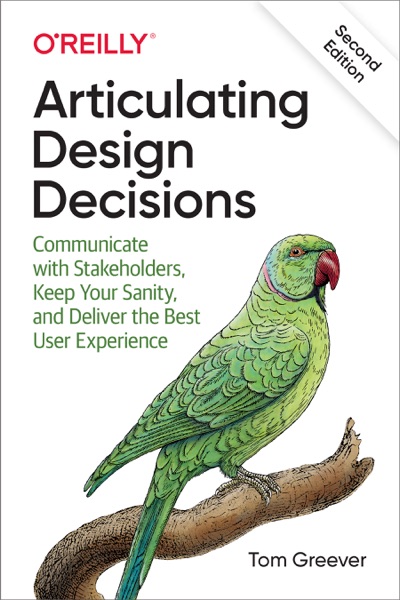
Articulating Design Decisions by Tom Greever is a 2015 business book about design communication, stakeholder management, ux design. Good design decisions that you can't explain are professionally worthless in organizational settings. Communication is part of the designer's core competency, not a separate skill.
Summary
Articulating Design Decisions addresses a gap that most design education ignores: knowing how to make good decisions is necessary but not sufficient. You also have to be able to explain and defend them to people who don't share your visual vocabulary, aren't thinking about user experience, and have their own organizational goals driving their objections. Tom Greever, a UX director with experience working in cross-functional teams, wrote this book from the accumulation of those conversations and the patterns he observed in which explanations worked and which didn't.
The book's core argument is that design is inherently collaborative in organizations, and that treating design reviews as adversarial — where you defend your work against critics — is a losing strategy regardless of who is right. Greever reframes the stakeholder conversation as a shared problem-solving process. The designer's job in a meeting is not to win but to understand what the stakeholder is actually concerned about (which is often not what they're literally saying), find the legitimate interest behind the objection, and address that interest in terms the stakeholder can evaluate.
The practical framework Greever offers has three parts: listen, understand, respond. Much of the book is about the listening and understanding parts, which are often underdeveloped in designers who have been taught that rigorous process is self-justifying. He gives specific language for common situations — how to respond to a personal-taste objection, how to handle a stakeholder who wants to add something, how to deal with HiPPO dynamics (Highest Paid Person's Opinion) — and how to tell when feedback reflects a legitimate concern versus a bad instinct.
A second edition was published in 2024, updating the examples for contemporary tools and adding material on remote design review processes. The book is focused on product and digital design, but the core communication and negotiation framework applies broadly to any work where a specialist has to explain technical or aesthetic decisions to non-specialists who hold organizational authority.
Talk to Articulating Design Decisions like its author wrote you back.
Get the ideas that fit your life — not generic summaries.
- Chat with the book
- Audiobook-style main ideas
- Adapts to your life and goals
- Helps you take action
Key takeaways
- 1.
Good design decisions that you can't explain are professionally worthless in organizational settings. Communication is part of the designer's core competency, not a separate skill.
- 2.
Most stakeholder objections contain a legitimate concern obscured by imprecise language. The designer's job is to find that concern and address it, not to rebut the surface statement.
- 3.
The listen-understand-respond framework: resist the impulse to defend immediately. Ask clarifying questions before formulating your answer.
- 4.
Personal taste objections ('I don't like it') are the hardest to handle because they're not falsifiable. Redirect to the user or the goal: 'What concern does that reflect about the user's experience?'
- 5.
HiPPO dynamics — where the most senior person's preference overrides everyone else — are a political reality. Managing them requires building relationships before the meeting, not winning arguments during it.
- 6.
Data and research are useful in design conversations, but only if you've set up the right conditions for them to be heard. Presenting data to a stakeholder who hasn't agreed on what counts as evidence is rarely persuasive.
- 7.
The goal of a design review conversation is not to leave with your design unchanged. It's to leave with a shared understanding of what the right decision is. Sometimes that means changing the design.
Discussion questions
Use these on your own, with a book club, or as chat starters in Superbook. Book club version, ready to copy or print →
- 1.
Greever argues that design communication is part of the designer's core competency, not a separate skill. Do the design programs and workplaces you know treat it that way?
- 2.
Think of a time you made a sound design decision that was overruled by a stakeholder. Using Greever's framework, what might you have done differently in that conversation?
- 3.
He distinguishes between a stakeholder's stated objection and their actual concern. Can you think of an example from your own experience where those were different things?
- 4.
The HiPPO problem — senior authority overriding considered judgment — exists in most organizations. What strategies beyond the ones Greever offers have you found useful?
- 5.
Greever says the goal of a design review is not to leave with your design unchanged. Is that framing empowering or demoralizing to you?
- 6.
He offers specific language for common situations. Did any of the scripts he provides feel natural to use, or do they feel like scripts that would be obvious to the listener?
- 7.
The book is focused on digital product design. How much of the framework transfers to other types of design work — graphic design, architecture, industrial design?
- 8.
Research and data are presented as useful but insufficient for persuasion. What makes some data presentations persuasive and others irrelevant in your experience?
- 9.
How do you currently prepare for a design review? Does Greever's approach change anything about that preparation?
- 10.
He argues that treating stakeholder conversations as adversarial is a losing strategy regardless of who is right. Do you agree, or are there situations where you need to hold a position firmly?
- 11.
What's the hardest type of stakeholder feedback for you to handle well? Does the book give you a better approach for that specific situation?
Themes
Frequently asked questions
-
What is Articulating Design Decisions about?
Tom Greever's guide to communicating and defending design choices in organizational settings — specifically how to have productive conversations with stakeholders who don't share your design vocabulary and have their own concerns driving their feedback.
-
Is Articulating Design Decisions only useful for UX designers?
No. The core framework — understanding the legitimate concern behind a surface objection, finding shared ground, addressing concerns in terms the other person can evaluate — applies to any professional who has to explain technical or specialized decisions to non-specialists.
-
How long is Articulating Design Decisions?
Around 250 pages in the first edition. At average pace it reads in three to four hours. The second edition (2024) added material and updated examples for remote work and contemporary tools.
-
What's the most actionable idea in Articulating Design Decisions?
The distinction between the stated objection and the actual concern. When a stakeholder says 'I don't like it,' asking 'what specifically concerns you about the user's experience here?' reframes the conversation from taste to goals and gives both parties something concrete to address.
-
Does Articulating Design Decisions teach you to win arguments?
No, and that framing is explicitly what Greever argues against. The goal is shared understanding and the right decision — which sometimes means changing your design. The book teaches you to have better conversations, not to defend bad decisions more effectively.