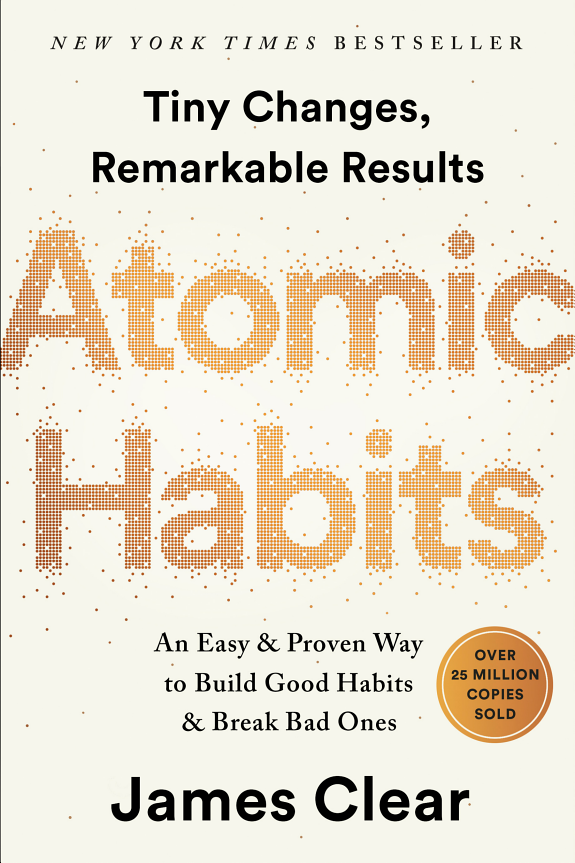
Talk to Atomic Habits like its author wrote you back.
Get the ideas that fit your life — not generic summaries.
- Chat with the book
- Audiobook-style main ideas
- Adapts to your life and goals
- Helps you take action
What it argues
Atomic Habits is James Clear's framework for how very small changes — habits so minor they seem to make no difference on any given day — compound into remarkable results over months and years. His central reframe is that you do not rise to the level of your goals; you fall to the level of your systems. The people we credit with discipline are rarely running on willpower. They've built systems and environments that make the good behavior the path of least resistance and the bad behavior the friction-heavy exception.
The math is the hook: improving by 1% a day leaves you roughly thirty-seven times better over a year, while declining 1% a day grinds you down to almost nothing. But compounding is also why habits are hard to keep — for a long time the results lag the effort. Clear calls this the Plateau of Latent Potential, the "valley of disappointment" where it feels like nothing is working, right up until the breakthrough. Most people quit in the valley.
What it gets right
- 1.
You don't rise to the level of your goals, you fall to the level of your systems. The systems you build determine what you actually do day to day.
- 2.
Habits compound. A 1% improvement every day for a year leaves you roughly 37 times better; a 1% decline drops you to almost nothing in the same time.
- 3.
Identity-based habits stick because every action becomes a vote for who you're becoming, not just a step toward a distant goal.
What it covers
Who wrote it
James Clear is an American writer focused on habits, decision-making, and continuous improvement. He runs jamesclear.com and publishes the "3-2-1 Thursday" newsletter to over two million readers. Before writing full-time he was a competitive baseball player and a college science writer. Atomic Habits, published in 2018, has sold more than 15 million copies and is the most widely read modern book on behavior change.
