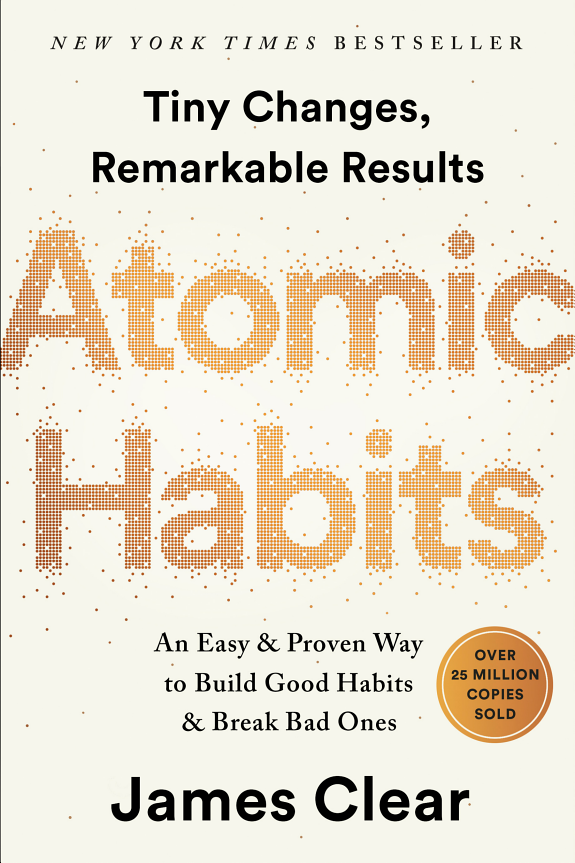
Atomic Habits by James Clear is a 2018 self-help book about habits, behavior change, systems thinking. You don't rise to the level of your goals, you fall to the level of your systems. The systems you build determine what you actually do day to day.
Summary
Atomic Habits is James Clear's framework for how very small changes — habits so minor they seem to make no difference on any given day — compound into remarkable results over months and years. His central reframe is that you do not rise to the level of your goals; you fall to the level of your systems. The people we credit with discipline are rarely running on willpower. They've built systems and environments that make the good behavior the path of least resistance and the bad behavior the friction-heavy exception.
The math is the hook: improving by 1% a day leaves you roughly thirty-seven times better over a year, while declining 1% a day grinds you down to almost nothing. But compounding is also why habits are hard to keep — for a long time the results lag the effort. Clear calls this the Plateau of Latent Potential, the "valley of disappointment" where it feels like nothing is working, right up until the breakthrough. Most people quit in the valley.
Underneath every habit is a four-step loop — cue, craving, response, reward — and Clear converts it into four practical laws of behavior change: make it obvious, make it attractive, make it easy, and make it satisfying. Each law comes with concrete tactics: implementation intentions and habit stacking to engineer the cue, temptation bundling to load the craving, the two-minute rule and friction reduction to ease the response, and habit tracking to make the reward immediate. To break a habit, you invert all four — make it invisible, unattractive, difficult, and unsatisfying.
The deepest layer is identity. Most people change from the outside in, starting with outcomes ("lose ten pounds"); Clear argues durable change runs from the inside out, starting with identity ("I'm the kind of person who doesn't miss workouts"). Every action becomes a vote for the type of person you wish to become, which is why he says the goal is not to read a book but to become a reader.
What sets the book apart from most habit advice is its specificity — it hands you sentences to write, environments to redesign, and frictions to add or remove rather than a vague call to be more disciplined. It synthesizes a good deal of existing behavioral science (Duhigg's habit loop, BJ Fogg's tiny habits, behavioral economics) rather than breaking new theoretical ground, so well-read readers will recognize some of the pieces. But as a practical operating manual for changing what you actually do, it's the clearest and most-used book on the shelf.
The four laws of behavior change
Every habit runs through the same loop — cue, craving, response, reward — and Clear turns that loop into four levers you can pull. Run all four forward to build a habit; invert them to break one.
1st law — Make it obvious (the cue)
You can’t change a behavior you’re not aware of, so the first job is to surface and engineer your cues.
- Habits Scorecard — list your daily habits and mark each one good, bad, or neutral. Awareness has to come before change.
- Implementation intentions — write the plan down: “I will [behavior] at [time] in [location].” A specific plan beats a vague intention.
- Habit stacking — anchor a new habit to one you already do: “After I pour my morning coffee, I will meditate for one minute.”
- Environment design — put the cue for the good habit in your line of sight, and give each habit its own context.
2nd law — Make it attractive (the craving)
The more appealing a behavior feels, the more likely it is to become a habit.
- Temptation bundling — pair something you want to do with something you need to do.
- Join a culture where your desired behavior is already the norm; we imitate the close, the many, and the powerful.
- Reframe the story — swap “I have to” for “I get to” so the habit’s payoff feels like a benefit, not a burden.
3rd law — Make it easy (the response)
Habits form through repetition, not perfection — so lower the activation energy.
- The two-minute rule — scale any habit down to a version that takes under two minutes. Read before bed becomes open the book.
- Reduce friction — every step you remove makes the good habit more likely; adding steps is how you starve a bad one.
- Prime the environment — set tomorrow’s habit up tonight: lay out the clothes, pre-pack the gym bag.
4th law — Make it satisfying (the reward)
What’s rewarded immediately gets repeated; what’s punished immediately gets avoided.
- Immediate reward — give yourself a small, instant payoff for habits whose real benefits are delayed.
- Habit tracking — mark an X on the calendar; don’t break the chain, and never miss twice.
- Accountability — a habit contract or a partner adds an immediate cost to skipping.
Breaking a bad habit: invert the laws
- Make it invisible — remove the cue from your environment.
- Make it unattractive — reframe the habit to highlight its real costs.
- Make it difficult — add friction or a commitment device between you and the behavior.
- Make it unsatisfying — make the consequences of a slip immediate and visible.
The ideas underneath the laws
Systems over goals
Goals set direction, but they’re a one-time event; systems are what you repeat. “You do not rise to the level of your goals. You fall to the level of your systems.” Winners and losers often share the same goals — the difference is the system that carries them there.
Identity-based habits
Behavior change has three layers: outcomes (what you get), processes (what you do), and identity (what you believe). Lasting change runs from identity outward — every action is a vote for the type of person you wish to become. The goal isn’t to read a book, it’s to become a reader.
The Plateau of Latent Potential
Habits often look like they’re doing nothing — until they cross a threshold and the results arrive all at once. Clear calls the gap the valley of disappointment: it’s where most people quit, mistaking a delay for a dead end.
The Goldilocks Rule
Motivation peaks when you work on tasks of just-manageable difficulty — not so easy you’re bored, not so hard you’re discouraged. The edge of your current ability is where you stay engaged.
The downside of habits
Automaticity is the point, but it carries a cost: once a behavior is effortless you stop paying attention, and small errors can calcify. Pair your habits with deliberate practice and periodic review so consistency doesn’t curdle into complacency.
Talk to Atomic Habits like its author wrote you back.
Get the ideas that fit your life — not generic summaries.
- Chat with the book
- Audiobook-style main ideas
- Adapts to your life and goals
- Helps you take action
Key takeaways
- 1.
You don't rise to the level of your goals, you fall to the level of your systems. The systems you build determine what you actually do day to day.
- 2.
Habits compound. A 1% improvement every day for a year leaves you roughly 37 times better; a 1% decline drops you to almost nothing in the same time.
- 3.
Identity-based habits stick because every action becomes a vote for who you're becoming, not just a step toward a distant goal.
- 4.
The four laws of behavior change: make it obvious, make it attractive, make it easy, make it satisfying. To break a habit, invert each law.
- 5.
Environment design matters more than motivation. If a behavior is hard to start, you won't start it. If a cue is in your face, you'll act on it.
- 6.
Habit stacking attaches a new habit to an existing reliable trigger. After I pour my morning coffee, I will meditate for one minute.
- 7.
The two-minute rule: scale every habit down until it takes less than two minutes to begin. Read before bed becomes open the book.
- 8.
Tracking progress is its own reward. Make habits satisfying in the short term so you actually repeat them long enough to see compounding results.
Discussion questions
Use these on your own, with a book club, or as chat starters in Superbook. Book club version, ready to copy or print →
- 1.
Clear says systems beat goals. Which goal in your life right now is being undermined by a missing system?
- 2.
What habit are you trying to build that would feel easier if you reframed it as an identity rather than a target?
- 3.
Pick one of your bad habits. Which of the four laws of behavior change makes it so sticky for you?
- 4.
Which environment in your daily life is quietly pulling you toward behavior you don't actually want?
- 5.
What habit are you currently trying to do for too long at a time? What would the two-minute version of it look like?
- 6.
Habit stacking needs an existing reliable trigger. List five things you do every day at roughly the same time. Could any of them anchor a new habit?
- 7.
Clear distinguishes motion from action: planning from doing. Where in your life are you in motion but not in action right now?
- 8.
What's a recent example in your own life where a 1% improvement compounded into something larger?
- 9.
Which of your habits is invisible to you now because you've done it so long? Is it still serving you?
- 10.
The book argues you should be the kind of person who shows up, not the kind who waits for motivation. What does showing up look like for the area of life you most want to improve?
- 11.
Who in your life models a habit you'd like to adopt? What environments do they seem to design around themselves?
- 12.
If you redesigned your phone, your kitchen, and your workspace to make one good habit easier, which habit would you pick and what specifically would you change?
- 13.
Clear warns about the plateau of latent potential, where you put in effort but don't see results yet. Have you quit something at that stage? What would you do differently now?
Themes
Frequently asked questions
-
Is Atomic Habits worth reading?
Yes, especially if you've struggled to make habits stick despite knowing what you should do. The book's strength is specificity: it gives you concrete tools rather than general motivation. If you've already read widely on habit formation some material will feel familiar, but the frameworks are unusually practical and the writing is clear.
-
How long does it take to read Atomic Habits?
Roughly five to six hours at average reading pace for the 320-page book. Many readers finish it in a weekend. The chapters are short and self-contained, so it works well in twenty-minute reading sessions where you can put one idea into practice between chapters.
-
What are the four laws of behavior change in Atomic Habits?
Make it obvious, make it attractive, make it easy, and make it satisfying — the four levers Clear derives from the cue-craving-response-reward habit loop. You run all four forward to build a good habit, and invert them (invisible, unattractive, difficult, unsatisfying) to break a bad one.
-
Who should read Atomic Habits?
Anyone trying to change a behavior who has found willpower alone doesn't work. It's most useful for people who want a structured framework for building or breaking specific habits, and for managers, parents, and coaches who want to shape behavior in others without relying on motivation.
-
What's the most actionable idea in Atomic Habits?
The two-minute rule. Pick the habit you want to build, then shrink it down until it takes less than two minutes to do. Run three miles becomes put on running shoes. This bypasses the willpower problem because the entry cost is too small to skip, and once you've started you usually keep going.
Similar books
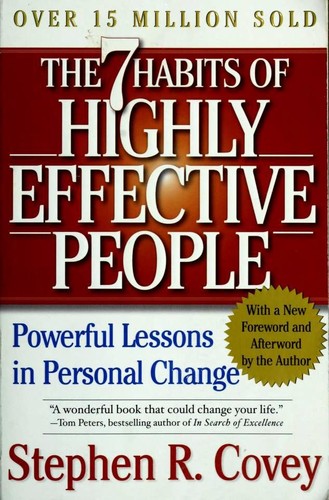
Atomic Habits vs.
Deciding between two books? Atomic Habits vs The Compound Effect , Atomic Habits vs The Power of Habit , Atomic Habits vs Tiny Habits , Atomic Habits vs The 7 Habits of Highly Effective People or Atomic Habits vs Deep Work .
