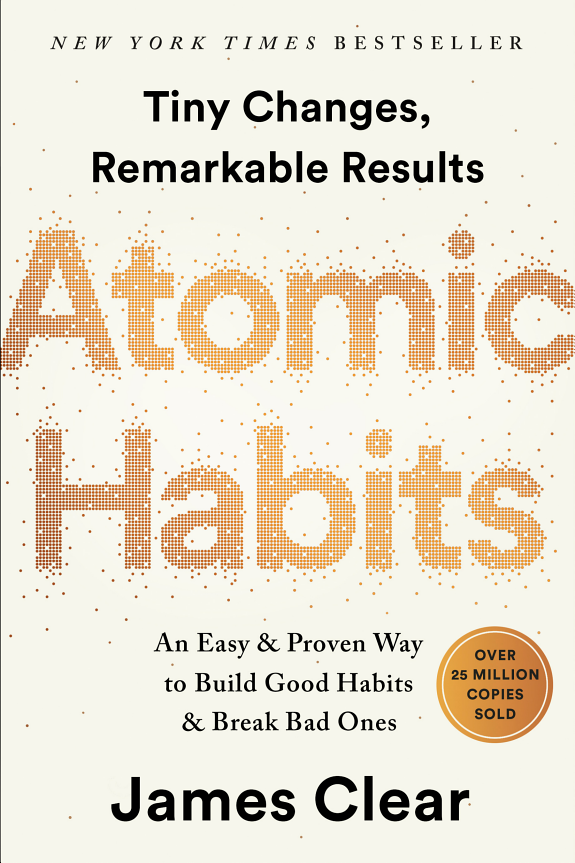
Talk to Atomic Habits like its author wrote you back.
Get the ideas that fit your life — not generic summaries.
- Chat with the book
- Audiobook-style main ideas
- Adapts to your life and goals
- Helps you take action
Atomic Habits, in detail
Atomic Habits is James Clear's framework for how very small changes — habits so minor they seem to make no difference on any given day — compound into remarkable results over months and years. His central reframe is that you do not rise to the level of your goals; you fall to the level of your systems. The people we credit with discipline are rarely running on willpower. They've built systems and environments that make the good behavior the path of least resistance and the bad behavior the friction-heavy exception.
The math is the hook: improving by 1% a day leaves you roughly thirty-seven times better over a year, while declining 1% a day grinds you down to almost nothing. But compounding is also why habits are hard to keep — for a long time the results lag the effort. Clear calls this the Plateau of Latent Potential, the "valley of disappointment" where it feels like nothing is working, right up until the breakthrough. Most people quit in the valley.
Underneath every habit is a four-step loop — cue, craving, response, reward — and Clear converts it into four practical laws of behavior change: make it obvious, make it attractive, make it easy, and make it satisfying. Each law comes with concrete tactics: implementation intentions and habit stacking to engineer the cue, temptation bundling to load the craving, the two-minute rule and friction reduction to ease the response, and habit tracking to make the reward immediate. To break a habit, you invert all four — make it invisible, unattractive, difficult, and unsatisfying.
The deepest layer is identity. Most people change from the outside in, starting with outcomes ("lose ten pounds"); Clear argues durable change runs from the inside out, starting with identity ("I'm the kind of person who doesn't miss workouts"). Every action becomes a vote for the type of person you wish to become, which is why he says the goal is not to read a book but to become a reader.
What sets the book apart from most habit advice is its specificity — it hands you sentences to write, environments to redesign, and frictions to add or remove rather than a vague call to be more disciplined. It synthesizes a good deal of existing behavioral science (Duhigg's habit loop, BJ Fogg's tiny habits, behavioral economics) rather than breaking new theoretical ground, so well-read readers will recognize some of the pieces. But as a practical operating manual for changing what you actually do, it's the clearest and most-used book on the shelf.
The big ideas
- 1.
You don't rise to the level of your goals, you fall to the level of your systems. The systems you build determine what you actually do day to day.
- 2.
Habits compound. A 1% improvement every day for a year leaves you roughly 37 times better; a 1% decline drops you to almost nothing in the same time.
- 3.
Identity-based habits stick because every action becomes a vote for who you're becoming, not just a step toward a distant goal.
