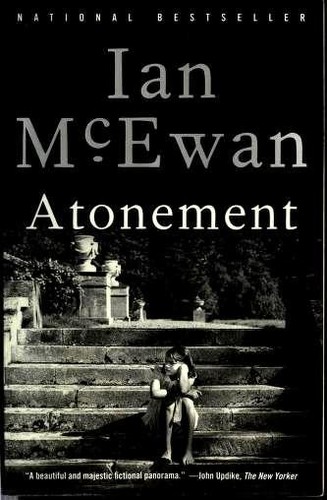
Talk to Atonement like its author wrote you back.
Get the ideas that fit your life — not generic summaries.
- Chat with the book
- Audiobook-style main ideas
- Adapts to your life and goals
- Helps you take action
What it argues
Atonement begins on a hot summer day in 1935 at a Surrey country estate. Thirteen-year-old Briony Tallis witnesses and half-understands events involving her older sister Cecilia and Robbie Turner, the housekeeper's son and Cambridge graduate who is in love with Cecilia. Briony misreads what she sees — a charged encounter at a fountain, an explicit letter — and when a real crime occurs that night, she identifies Robbie as the perpetrator. Her testimony sends him to prison and, later, to Dunkirk. The first section is a chamber drama of extraordinary precision; McEwan tracks adolescent interiority with almost surgical care.
The novel's second and third sections move through the Second World War — Robbie's retreat to Dunkirk among the British Expeditionary Force, Cecilia and Briony nursing in a London hospital. McEwan writes the Dunkirk sections with the same physical specificity he brings to the Surrey drawing rooms of Part One: exhaustion, confusion, the smell of gangrene, the randomness of who survives. The novel's structure suggests that the war is not only a historical backdrop but a kind of literalization of what Briony's lie has done — a massive, senseless rupture in lives that had a different trajectory.
What it gets right
- 1.
A single misreading by an imaginative child destroys two lives — the novel is relentless about how much damage perception and narrative can cause.
- 2.
McEwan tracks Briony's adolescent imagination as both sympathetic (she is a child; she is artistic; she misunderstands) and inexcusable (she had enough information to doubt herself).
- 3.
The Dunkirk sections are among the most controlled literary accounts of that catastrophe — physical, disorienting, stripped of heroism without being anti-heroic.
What it covers
Who wrote it
Ian McEwan is one of Britain's most celebrated novelists, whose work spans psychological thrillers, literary fiction, and speculative scenarios of ordinary life under pressure. His novels include The Cement Garden, The Child in Time, Enduring Love, Amsterdam (which won the Booker Prize in 1998), Saturday, On Chesil Beach, Solar, Sweet Tooth, and Nutshell. Atonement, published in 2001, was a Booker finalist and the basis for a 2007 film directed by Joe Wright. He is widely regarded as a master of controlled, precise prose.
