Historical fiction · Book club
Babel book club questions
Here are 12 book club questions for Babel by R.F. Kuang, ordered to open easily and end somewhere worth arguing about. Copy them, print them, or bring them up one at a time.
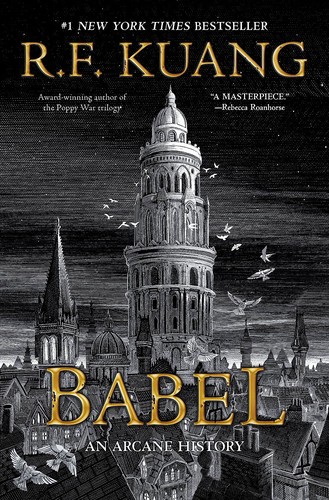
Set in an alternate 1830s Oxford, Babel imagines a Royal Institute of Translation at the heart of the British Empire — a place where silver bars engraved with translation "match-words" generate the industrial magic that powers British supremacy.
R.F. Kuang · 2022 · 11h 0m
Full summary and key takeaways →The 12 questions
- 1.
Robin understands the Empire's injustice but benefits from it for most of the novel. At what point, if any, does understanding obligate action? Does the book answer this question or ask it?
- 2.
The silver-working magic requires two languages and the gap between them. What does it mean that British power literally runs on the labor of translation — on the linguistic knowledge of colonized peoples?
- 3.
Each member of the cohort makes a different choice about how to respond to their situation. Whose choice do you find most defensible? Most comprehensible?
- 4.
The footnotes are real historical information. Did they change how you read the fictional frame, and do you think that was Kuang's intent?
- 5.
Ramy's relationship with Robin is arguably the emotional center of the book. How does their friendship complicate the political arguments Kuang is making?
- 6.
The Hermes Society offers another model of resistance. What does the novel think of it, and is that portrayal fair?
- 7.
Kuang draws explicit parallels to contemporary politics — this isn't subtle historical allegory. Is that explicitness a strength or a limitation?
- 8.
Professor Lovell is presented as a specific kind of villain: a man who genuinely believes he is doing good. Is that more frightening than straightforward malice?
- 9.
Compared to Jonathan Strange & Mr. Norrell — another Oxford-adjacent alternate history with a magic system — what does each book's approach to British imperial power reveal that the other doesn't?
- 10.
The novel is formally demanding (long, footnote-heavy, essayistic). Did you find the form served the content, or would the argument have worked better in a different shape?
- 11.
Victoire's perspective is the one we get least of. Does that feel like a structural gap, or does it serve the novel's purposes?
- 12.
The ending is a choice that forecloses other choices. Was it earned by what came before, and did the book prepare you for it?
How to run the discussion
- Pick six to eight, not all of them. An hour of real discussion covers fewer questions than anyone expects, and racing the list is what makes a book club feel like homework.
- Open with what people noticed, not what they concluded. Asking for a verdict first hardens opinions before anyone has heard each other.
- Let the disagreement run. The questions below that split a room are the ones worth the time; the ones everyone answers the same way can be skipped.
- Ask the quiet person a specific question. A direct, narrow question is far easier to answer than an open invitation to contribute.
Themes worth steering toward
If the conversation stalls, these are the threads that usually restart it.
Common questions
What are good book club questions for Babel?
Here are 12 book club questions for Babel by R.F. Kuang, ordered to open easily and end somewhere worth arguing about. The strongest openers ask what each reader noticed rather than what they concluded, and the discussion usually turns on colonialism, language and power, complicity.
How long should a book club discussion of Babel last?
Most groups run 60 to 90 minutes of actual discussion. That is roughly six to eight questions, not all of them, so pick the ones that suit your group rather than working down the list in order.
What are the main themes in Babel?
Colonialism, Language and power, Complicity, Belonging and betrayal, Translation as violence. Those are the threads most likely to divide a room, which makes them the useful places to steer a discussion that has gone quiet.
Picking the next one? See books like Babel or questions for other book club picks.
