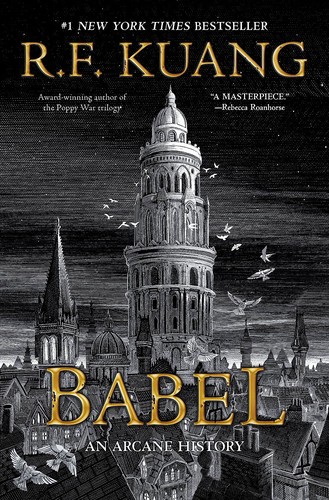
Talk to Babel like its author wrote you back.
Get the ideas that fit your life — not generic summaries.
- Chat with the book
- Audiobook-style main ideas
- Adapts to your life and goals
- Helps you take action
What it argues
Set in an alternate 1830s Oxford, Babel imagines a Royal Institute of Translation at the heart of the British Empire — a place where silver bars engraved with translation "match-words" generate the industrial magic that powers British supremacy. Robin Swift, orphaned in Canton and brought to England by a mysterious professor, spends his childhood being shaped into the perfect scholar. When he enters Babel, he is brilliant, grateful, and deeply compromised before the story begins.
The book is fundamentally about complicity. Kuang is interested in the mechanics of how empire recruits its best critics into its own service — how gifted people from colonized populations are selected, groomed, and made to feel that their advancement proves the system's fairness. Robin is not naive; he understands what Oxford and the Empire represent. But understanding is not the same as resistance, and the novel traces with uncomfortable precision the gap between the two. His cohort of friends — each from a different colonized population, each carrying their own version of this bargain — develop into a study in the different choices available to people in impossible positions.
What it gets right
- 1.
Empire recruits its sharpest critics by offering them a seat at the table — and the novel asks what it costs to take that seat and what it costs to refuse it.
- 2.
Translation is not a neutral act. Every act of translation involves choices that carry political weight, and Babel's magic system literalizes what is lost and wielded in those gaps.
- 3.
Belonging is a trap the empire sets. Robin's love of Oxford is genuine and also manufactured, and Kuang refuses to let that contradiction resolve cleanly.
What it covers
Who wrote it
R.F. Kuang is a British-American novelist and academic whose work explores colonialism, empire, and violence through fantasy frameworks. Her Poppy War trilogy — a dark fantasy based on twentieth-century Chinese history — established her as a major voice in the genre before Babel became her breakout mainstream hit. She holds degrees from Georgetown, Cambridge, and Oxford, and the academic precision in Babel reflects her scholarly work on translation and empire. Yellowface, her 2023 satirical novel about racial dynamics in publishing, extended her range into contemporary fiction.
