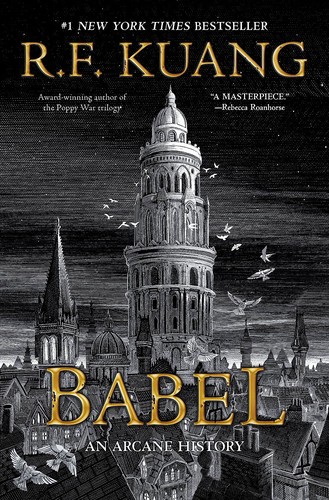
Talk to Babel like its author wrote you back.
Get the ideas that fit your life — not generic summaries.
- Chat with the book
- Audiobook-style main ideas
- Adapts to your life and goals
- Helps you take action
Babel, in detail
Set in an alternate 1830s Oxford, Babel imagines a Royal Institute of Translation at the heart of the British Empire — a place where silver bars engraved with translation "match-words" generate the industrial magic that powers British supremacy. Robin Swift, orphaned in Canton and brought to England by a mysterious professor, spends his childhood being shaped into the perfect scholar. When he enters Babel, he is brilliant, grateful, and deeply compromised before the story begins.
The book is fundamentally about complicity. Kuang is interested in the mechanics of how empire recruits its best critics into its own service — how gifted people from colonized populations are selected, groomed, and made to feel that their advancement proves the system's fairness. Robin is not naive; he understands what Oxford and the Empire represent. But understanding is not the same as resistance, and the novel traces with uncomfortable precision the gap between the two. His cohort of friends — each from a different colonized population, each carrying their own version of this bargain — develop into a study in the different choices available to people in impossible positions.
Kuang writes with academic energy. The footnotes are real (and often devastating), the historical parallels are drawn explicitly rather than metaphorically, and the prose has an essayistic quality that will please some readers and exhaust others. This is fantasy in service of argument. The silver magic system is an elegant vehicle for exploring what translation actually does to meaning — how the gap between languages contains the gap between worldviews, and how empire fills that gap with force.
The book runs long and it knows it; Kuang is making a case, not just telling a story. Readers who want the argument will find it relentless in the best sense. Readers who want character-first fiction may find Robin's arc more schematic than felt. It compares well to Jonathan Strange & Mr. Norrell in its alternate-history Oxford setting, but where Clarke is ironic and oblique, Kuang is direct and angry. Both are worth reading. This one is harder to put down once it has you.
The big ideas
- 1.
Empire recruits its sharpest critics by offering them a seat at the table — and the novel asks what it costs to take that seat and what it costs to refuse it.
- 2.
Translation is not a neutral act. Every act of translation involves choices that carry political weight, and Babel's magic system literalizes what is lost and wielded in those gaps.
- 3.
Belonging is a trap the empire sets. Robin's love of Oxford is genuine and also manufactured, and Kuang refuses to let that contradiction resolve cleanly.
